Performance Marketing & Lead Generation: The Complete Guide
Author: Richa Naik, Digital Marketing Manager
Date : 4 August 2026
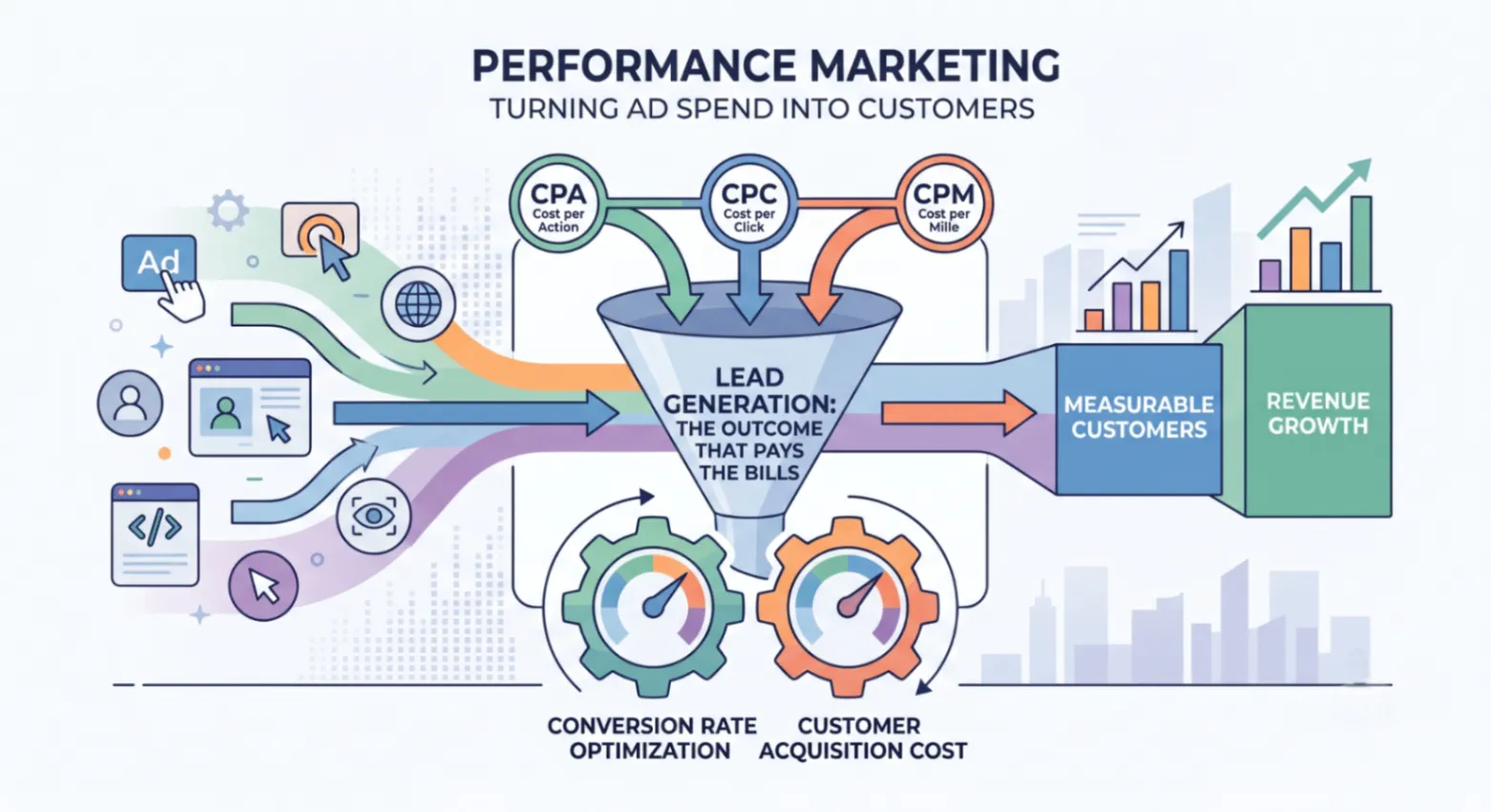
Performance marketing is advertising measured by outcomes rather than exposure, and lead generation is the outcome most businesses are actually buying. The field looks complicated from the outside — a wall of acronyms, platforms, and dashboards — but underneath it is one coherent system for turning ad spend into paying customers. This guide is the map. It explains how the pieces fit together and links to a deeper article on each, so you can read top to bottom for the whole picture or jump straight to the piece you need.
The Core Idea: Pay for Results, Not Placements
Traditional advertising buys exposure and hopes it works. Performance marketing ties the invoice to something measurable — a click, a lead, a sale — so you can draw a straight line from spend to result. That single shift is why budgets have moved toward it, and it is the foundation everything below is built on. If you are new to the concept, start with our primer on what performance marketing is, then come back here for how the whole system connects.
The Three Pricing Models
Nearly every performance campaign runs on one of three pricing structures, each answering a different question about where your money should work.
CPA — cost per action charges only when a defined action completes, such as a sale or a qualified lead. It is the most accountable model and the natural engine for lead generation, because you pay for outcomes rather than exposure.
CPC — cost per click, the basis of PPC charges each time someone clicks your ad. It is how you buy targeted, intent-driven traffic and feed the top of a conversion funnel.
CPM — cost per mille charges per thousand impressions and exists to build awareness. It does not generate leads directly, but it makes later CPC and CPA work convert more cheaply by warming the audience first.
The models are not rivals to pick between — they are stages of one funnel, which is why the strongest programs blend all three.
Turning Traffic Into Customers
Traffic is not the goal; customers are, and the gap between the two is where most budgets quietly leak. Two disciplines close it. Conversion rate optimization improves how many of your existing visitors actually act — often the highest-leverage work available, because doubling conversion effectively halves your cost per customer without spending a cent more on traffic. And customer acquisition cost is the metric that tells you whether the whole system is profitable, by measuring the full cost of winning one paying customer rather than a flattering top-line number.
Lead Generation: The Outcome That Pays the Bills
For most businesses the action worth paying for is a qualified lead. But volume and value are different things, and a program optimized for cheap leads that never close is an expensive way to keep a sales team busy. Our guide to lead generation strategies that convert covers how to define quality with sales, build offers that attract serious prospects, and respond fast enough to actually reach them. Selling to businesses changes the playbook again — longer cycles, multiple decision-makers, higher stakes — which is why B2B lead generation deserves its own approach.
Scaling Without Breaking
Once campaigns run across several models and platforms at once, two capabilities decide whether you scale smoothly or drown. Media buying is the strategic side of securing the right ad placements at the right rates — especially critical for CPM, where poor buying can hit an impression target while missing the audience that matters. And marketing automation absorbs the repetitive execution — follow-up, bid adjustments, lead scoring — so campaigns grow in volume and channels without a matching growth in manual effort.
Choosing Your Mix
Few businesses live on a single model. A typical full-funnel blend uses CPM to build visibility, CPC to pull qualified traffic, and CPA to convert that traffic into measurable actions, with CRO lifting the conversion rate at each step and automation holding it all together. The right balance depends on your funnel, margins, and sales cycle — not on a rule of thumb that one model beats another.
Measuring What Matters
The most common measurement mistake is stopping at the first available number instead of following the funnel to a real customer. Judge campaigns on customer acquisition cost calculated separately by channel, over an attribution window that matches your actual sales cycle, and remember that each model is measured differently — reach and frequency for CPM, clicks for CPC, completed actions for CPA. Comparing them on the wrong axis produces confident, wrong conclusions.
A Real-World Result
Strategy is easier to trust with proof. In a recent engagement, three of our clients — all of whom asked to remain anonymous — were spending against audiences that simply were not converting. By redefining their target market and redirecting campaigns toward the segments that matched their real buyers, we increased those clients' revenue by 200%. It is a reminder that the biggest gains often come not from spending more, but from pointing the same spend at the right people.
Where to Start
If you are early, begin by defining what a valuable customer is worth to you — everything else is calibrated against that number. If you are already running campaigns, the fastest wins are usually in conversion rate and audience targeting rather than a bigger budget. And if the coordination across models and platforms has outgrown your team, that is the point where a specialist partner earns its keep. Explore our performance marketing services or get in touch to build a strategy around your business.
Ready to put this into practice? Contact 47 Yards to build a performance marketing strategy around your business.