CPM Advertising Explained: How Cost-Per-Mille Campaigns Build Brand Awareness
Author: Richa Naik, Digital Marketing Manager
Date : 4 August 2026
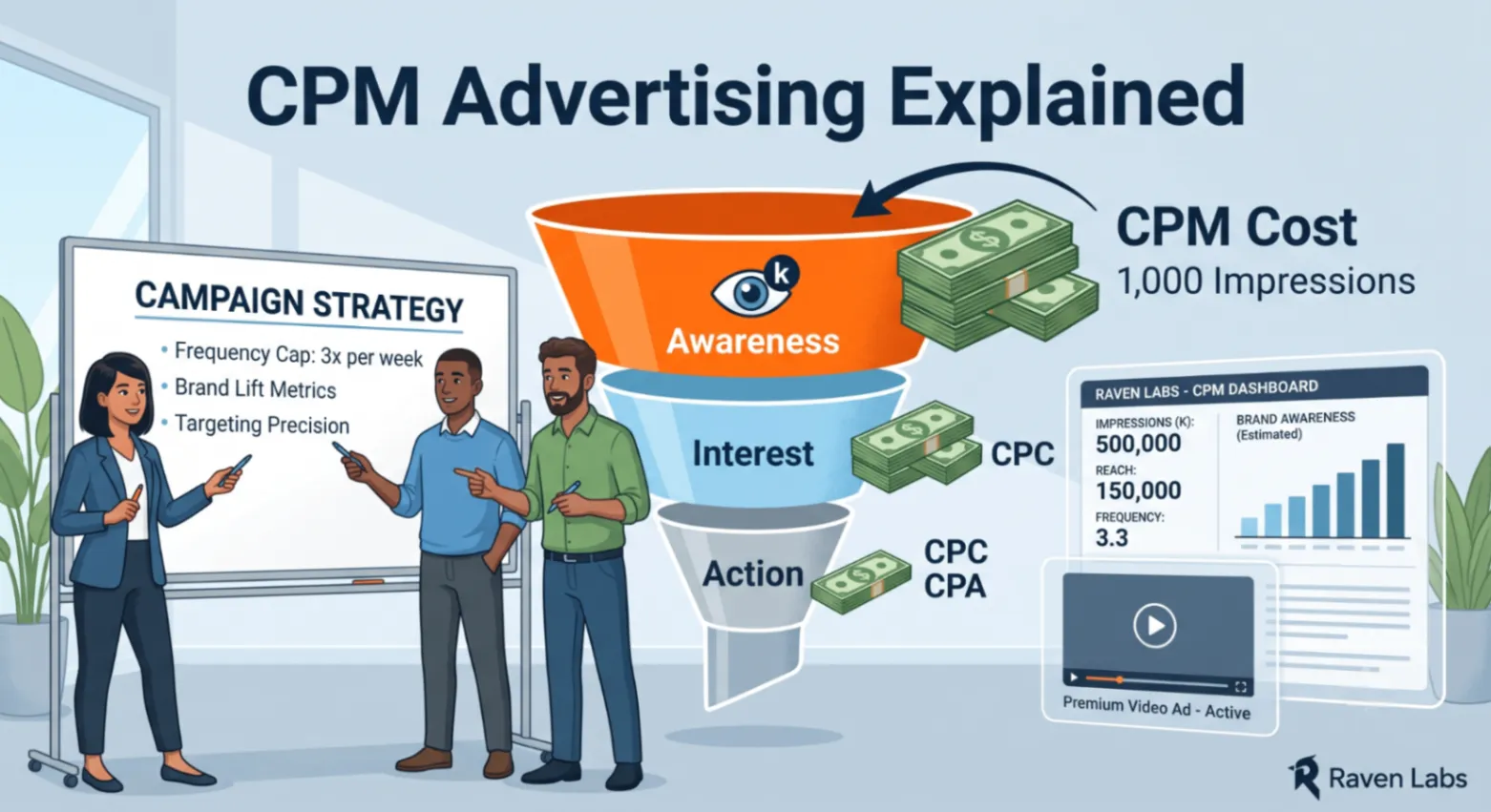
CPM — cost per mille, from the Latin for thousand — prices advertising by impressions, in blocks of a thousand. Unlike CPC or CPA, no click or action is required for cost to accrue; you pay for the ad being shown. That makes CPM the odd one out among the three performance marketing models, because it is built around visibility rather than a downstream action. Our performance marketing and lead generation guide shows how awareness feeds the rest of that funnel.
Why CPM Is Built for Awareness
Since cost is tied purely to impressions, CPM fits campaigns whose job is recognition, not immediate response — a new product launch, entering a new market, building familiarity with a target audience before you ever ask them to buy. If your goal this quarter is a direct, trackable conversion on a tight budget, CPM is the wrong first move; start with CPC or CPA and layer CPM in once there is room for longer-term brand building.
What CPM Rates Reflect
Rates swing with platform, targeting precision, placement quality, and demand for a given audience at a given moment. Premium, tightly targeted placements command higher CPMs than broad, undifferentiated inventory — you are paying for the value of reaching the right people, not just more people. Reaching the wrong audience cheaply is not a bargain.
Measure Past the Impression Count
Impressions are the billing unit, not the success metric. A CPM campaign that racks up impressions against the wrong audience delivers less than a smaller, precise one. Judge CPM on reach, frequency, and — where budget allows — a brand lift study, which measures shifts in awareness, favorability, or purchase intent before and after exposure. Brand lift is the closest CPM gets to a direct read on whether the money did its job.
Frequency Capping: The Setting That Protects Your Budget
Without a frequency cap, a CPM campaign can spend its whole budget showing the same ad to the same narrow group over and over, burning impressions on fatigue instead of reach.
Frequency capping limits how many times one person sees an ad in a set window. Set it too low and you never build recall; set it too high and you waste spend annoying people who already got the message. There is no universal number — it depends on message complexity and campaign length — but leaving it unset is almost always a mistake.
How CPM Feeds the Rest of the Funnel
CPM does not generate leads directly, but it makes later-stage work cheaper. Audiences already exposed to your brand through CPM convert more readily when they later meet a CPC or CPA campaign, which is why a blended, full-funnel approach usually beats direct-response alone.
A common, effective pattern: run broad CPM for awareness, then retarget the people it reached but who did not act — warm, already-primed, and far more responsive to a direct call to action on the second or third touch. This connects directly to media buying, where securing the right placements at the right rates decides how efficiently a CPM campaign reaches the audience that matters.
Creative Carries More Weight in CPM
Because you pay regardless of engagement, creative quality determines whether purchased impressions do anything. Ads built only to grab a moment's attention underperform creative that lands a clear message or value proposition in the first few seconds — critical on fast-scrolling feeds. Video generally earns higher recall than static, but it costs more to produce and often carries higher CPMs, so the choice should follow the goal and budget rather than a reflex that video is always better.
Setting a Budget That Actually Reaches People
CPM budgeting works backward from audience size and desired frequency to the total impressions you need. Underfund a CPM campaign relative to your audience and you buy too little frequency to build recall — technically running, functionally pointless. Estimate the reach you want, multiply by the frequency you need, and price the impressions before committing.
Watch for Audience Overlap
Running several CPM campaigns at once across platforms or segments can quietly double-count the same users, inflating reported reach and wasting spend on duplicates. Where platform tools allow it, check for overlap so your reach numbers reflect genuinely unique people.
Setting Expectations With Stakeholders
The most avoidable CPM failure is political, not technical: stakeholders used to direct-response dashboards look at a CPM report, see no conversions, and conclude it failed. Align everyone before launch on what success looks like — reach, frequency, brand lift, and downstream effect on later campaigns — and frame results in those terms afterward. A working awareness campaign should never be killed because it did not produce a CPA report.
The Bottom Line
CPM prices on impressions, which makes it the model for reach and awareness rather than immediate response. Done well — with careful platform selection, disciplined frequency capping, and strong creative, usually in combination with CPC and CPA further down the funnel — it builds the familiarity that makes everything else convert more cheaply over time. Explore our CPM advertising services to see how brand-building can complement your lead generation.
Ready to put this into practice? Contact 47 Yards to build a performance marketing strategy around your business.