CPA Marketing Explained: How Cost-Per-Action Campaigns Drive Real ROI
Author: Richa Naik, Digital Marketing Manager
Date : 4 August 2026
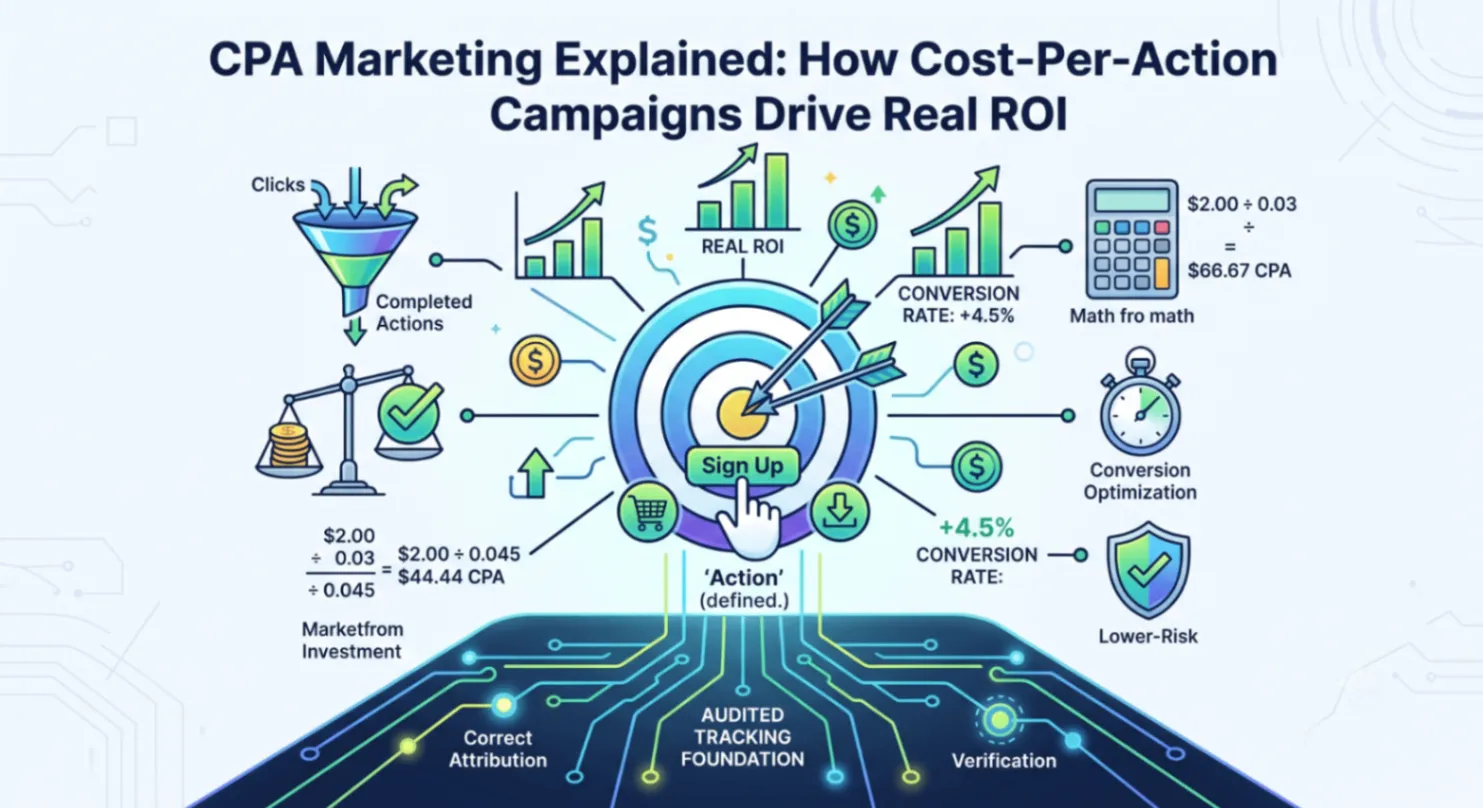
Cost-per-action pricing is the closest thing performance marketing has to paying only for what you get. You define an action — a form fill, a purchase, a trial sign-up — and you pay when it happens, not when an ad is shown or clicked. That single design choice is what makes CPA the most accountable model in the performance marketing toolkit, and it is why it maps so cleanly onto lead generation. It is one piece of the wider system covered in our performance marketing and lead generation guide.
Why CPA Is Considered Lower-Risk
Because payment triggers on a completed action, you are not funding wasted impressions or unqualified clicks that never convert. That makes CPA especially attractive when you have a clearly defined, high-value conversion event and little appetite for speculative spend. The risk of an underperforming campaign shifts toward the party running it rather than sitting entirely with the advertiser — genuinely useful, as long as you remember it does not eliminate risk, it relocates it.
The Math That Actually Governs CPA
CPA performance is often decided at the landing page, not the ad. The relationship is arithmetic, not opinion:
Suppose you pay $2.00 per click and your landing page converts 3% of visitors. Your effective cost per action is $2.00 ÷ 0.03 = $66.67. Improve that page to convert 4.5% — through clearer copy, a shorter form, faster load — and the same clicks now cost $2.00 ÷ 0.045 = $44.44 per action. That is a 33% cut in acquisition cost with zero change to your ad targeting or bid.
This is why conversion rate optimization is inseparable from CPA. Adjusting the ad gets attention; adjusting the page often moves the number more.
Setting a Realistic CPA Target
A CPA target set in a vacuum produces either timid campaigns that never scale or reckless ones that outrun the value they create. Anchor the target to real economics: work back from average customer value and your typical close rate. If a lead is worth $500 to you at a 20% close rate, each closed customer implies five leads, so a lead you can afford at, say, $60–$80 leaves healthy margin — and a $150 CPA does not. This is the same discipline behind customer acquisition cost: the CPA target should always be judged against what a paying customer is worth, never in isolation.
Common CPA Action Types
CPA campaigns get built around whatever action matches the business — a purchase for e-commerce, a form submission for a service firm, an app install for a mobile product, a trial sign-up for subscription software. For many businesses the action is a qualified lead, which is what makes CPA a backbone of most lead generation strategies. Choosing the right action to optimize toward is one of the highest-stakes early decisions, because the entire campaign is engineered to produce it as efficiently as possible.
Tracking Is the Foundation — Audit It
CPA pricing depends entirely on correctly detecting when the defined action occurred, so tracking errors do not just distort your reports — they mislead the platform's optimization, which steers spend toward whatever conversions it can see. Duplicate conversions, missed fires, and misattributed actions all corrupt the loop. Audit your conversion tracking on a schedule rather than assuming it still works because it worked at launch; a site redesign, a tag manager change, or a new consent banner can silently break it.
Scaling Without Losing Efficiency
CPA almost always rises as you scale, because the cheapest, warmest conversions get captured first and later spend reaches colder audiences. That is expected, not a failure. Managing the trade-off is ongoing work — pruning underperforming segments, refreshing creative, feeding the platform clean conversion signals — and it is exactly the kind of continuous, granular adjustment marketing automation handles better than a human doing it by hand.
Fraud and Low-Quality Conversions
Because CPA pays for completed actions, it attracts bad actors trying to manufacture payouts without genuine interest. Reputable platforms and partners run fraud detection and quality filters; before committing real budget, ask a prospective partner exactly what safeguards they apply and how filtered conversions are reflected in your reporting. Vague answers here are a red flag.
Where CPA Works Best — and Where It Struggles
CPA shines where there is a clearly defined, high-value conversion and an established sales process to catch it: financial services, insurance, subscription software, specialized B2B. It gets harder where the conversion event is fuzzy or where thin-margin, commoditized products cannot absorb the acquisition cost — those situations often favor CPC or CPM instead.
Don't Run CPA in Isolation
Cold audiences with no prior exposure to your brand convert worse in a pure CPA campaign than warm ones. Businesses that run CPA alone, with no awareness activity feeding it, often watch costs climb as the pool of already-familiar prospects runs dry and the campaign is forced into progressively colder audiences. Pairing CPA with even modest CPM or organic awareness keeps that pool topped up.
In one recent engagement, changing the target market — pointing three anonymized clients’ campaigns at the audiences that actually matched their buyers — increased their revenue by 200%. Audience targeting is one of the fastest levers on effective CPA, because a more relevant audience converts at a higher rate for the same spend.
The Bottom Line
CPA remains the most directly accountable performance model, tying spend to completed actions rather than exposure. Strong results come from accurate tracking, targets anchored to real customer value, landing pages that convert, and steady refinement as you scale — not from assuming the model does the work by itself. Explore our CPA marketing services to see how a structured CPA approach could apply to your business.
Ready to put this into practice? Contact 47 Yards to build a performance marketing strategy around your business.