Conversion Rate Optimization: Turning More Visitors Into Customers
Author: Richa Naik, Digital Marketing Manager
Date : 4 August 2026
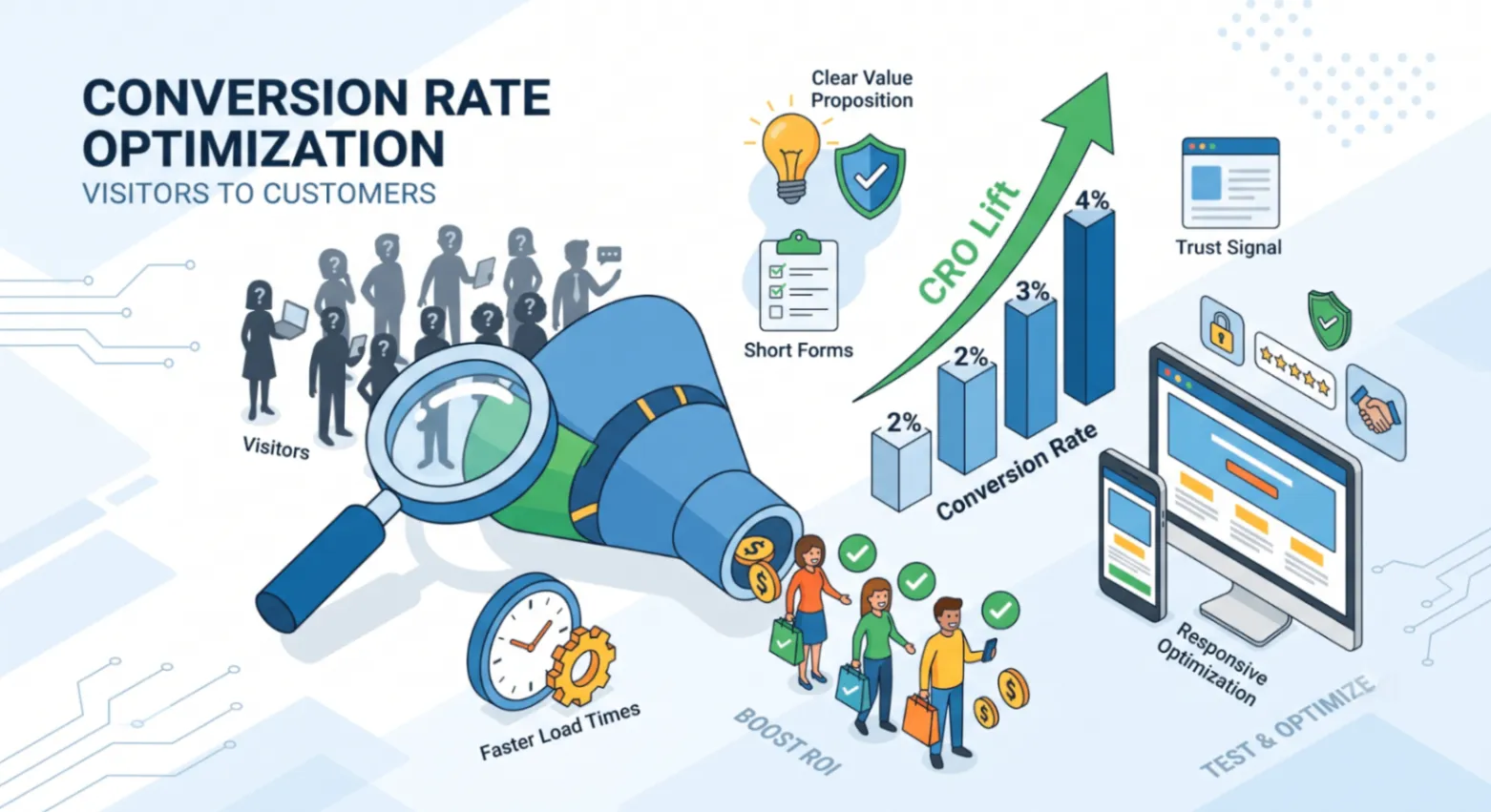
Conversion rate optimization is the discipline of getting more of your existing traffic to act — buy, submit, sign up — without paying for more visitors. It is one of the few levers in marketing that improves results without increasing spend, and for anyone running paid campaigns it is often the highest-leverage work available. See our complete guide to performance marketing and lead generation for where conversion fits the full picture.
Why CRO Is the Multiplier on Every Ad Dollar
Every dollar spent on CPA, CPC, or CPM becomes worth more when the resulting traffic converts better. The relationship is not vague — it is arithmetic:
A page that converts 2% turns 1,000 visitors into 20 customers. Lift it to 4% and the same 1,000 visitors produce 40 — you have doubled output with zero additional traffic cost. In a CPA campaign, doubling conversion rate effectively halves your cost per action, no change to bids or targeting required.
Driving more traffic to a poorly converting page just multiplies the same inefficiency. That is why CRO and paid strategy should be built together, not bolted on once the campaign is already spending.
Find the Barrier Before You Fix It
A handful of issues suppress most conversion rates: an unclear value proposition, forms that are too long, slow load times, and missing trust signals. But which one is throttling a specific page is a question for data, not best-practice checklists. Heatmaps and session recordings show where visitors actually click, how far they scroll, and where they hesitate or abandon — often surfacing a specific friction point that aggregate analytics would never reveal. Diagnose first; test second.
Test One Thing at a Time — and Have Enough Traffic to Trust It
Effective testing changes one variable at a time so you can attribute the result to a cause. Change five things at once and a lift tells you nothing about which change earned it. The other constraint is volume: A/B tests need enough traffic to reach statistical reliability, and calling a winner on too little data is how teams "learn" things that were really random noise. On low-traffic pages, be honest that a testing program will produce reliable answers slowly, and prioritize accordingly.
Prioritize the Pages That Matter
With limited time, optimize the highest-traffic, highest-value pages first — usually the primary landing pages tied to active paid campaigns — rather than spreading effort evenly across a whole site. Maintain a ranked testing roadmap ordered by expected impact and ease of implementation, so testing capacity goes to changes likely to move real numbers instead of whatever idea surfaced most recently.
Mobile Is Where Desktop Wins Go to Die
A page that converts beautifully on desktop can quietly bleed conversions on mobile, and with most traffic now mobile that drags down the whole number. Review mobile load times, form usability, and layout specifically — improvements that look done in a desktop review frequently do not survive the jump to a small screen and a thumb.
Trust Signals Are Industry-Specific
The signals that move conversion differ by context. Security badges and payment logos matter most at an e-commerce checkout; certifications, case studies, and client logos matter more on a B2B service page. Adding a generic set of trust badges regardless of audience does little — the ones that work are the ones your specific buyer was already looking for.
When to Stop Testing and Redesign
Sometimes a page's underlying structure or message is simply misaligned with the audience, and no amount of button-color testing will fix it. Recognizing when a page needs a rebuild rather than another incremental test is a judgment call, but the tell is usually a series of tests that all move the needle a fraction of a percent — a sign you are optimizing the wrong thing.
Pair the Numbers With Actual Human Feedback
Quantitative testing tells you what happens; it rarely tells you why. On-page surveys, short user tests, or simply asking recent customers what nearly stopped them from converting surface reasons that pure data misses. The teams with the best CRO results combine both — evidence for what to change, feedback for why.
Keep It Consistent, and On-Brand
CRO works best as a standing habit rather than an occasional project, because audiences, competitors, and platforms all shift. One guardrail: keep changes consistent with your brand and honest with your audience. A page that converts slightly better through an aggressive or misleading tactic can win this month and cost you trust and reputation over the year — a bad trade that eventually shows up in the numbers anyway. Marketing automation can run and evaluate variations faster than manual testing, but the judgment about what to test, and where to draw the line, stays human.
The Bottom Line
CRO improves the return on every dollar already spent on traffic, which makes it one of the highest-leverage activities in a performance strategy. Diagnose barriers with data and feedback, test cleanly with enough traffic to trust the result, respect mobile, and treat it as an ongoing habit rather than a one-time fix. Talk to our team about improving the conversion performance of your current campaigns.
Ready to put this into practice? Contact 47 Yards to build a performance marketing strategy around your business.