PPC Advertising 101: How Pay-Per-Click Campaigns Work
Author: Richa Naik, Digital Marketing Manager
Date : 5 August 2026
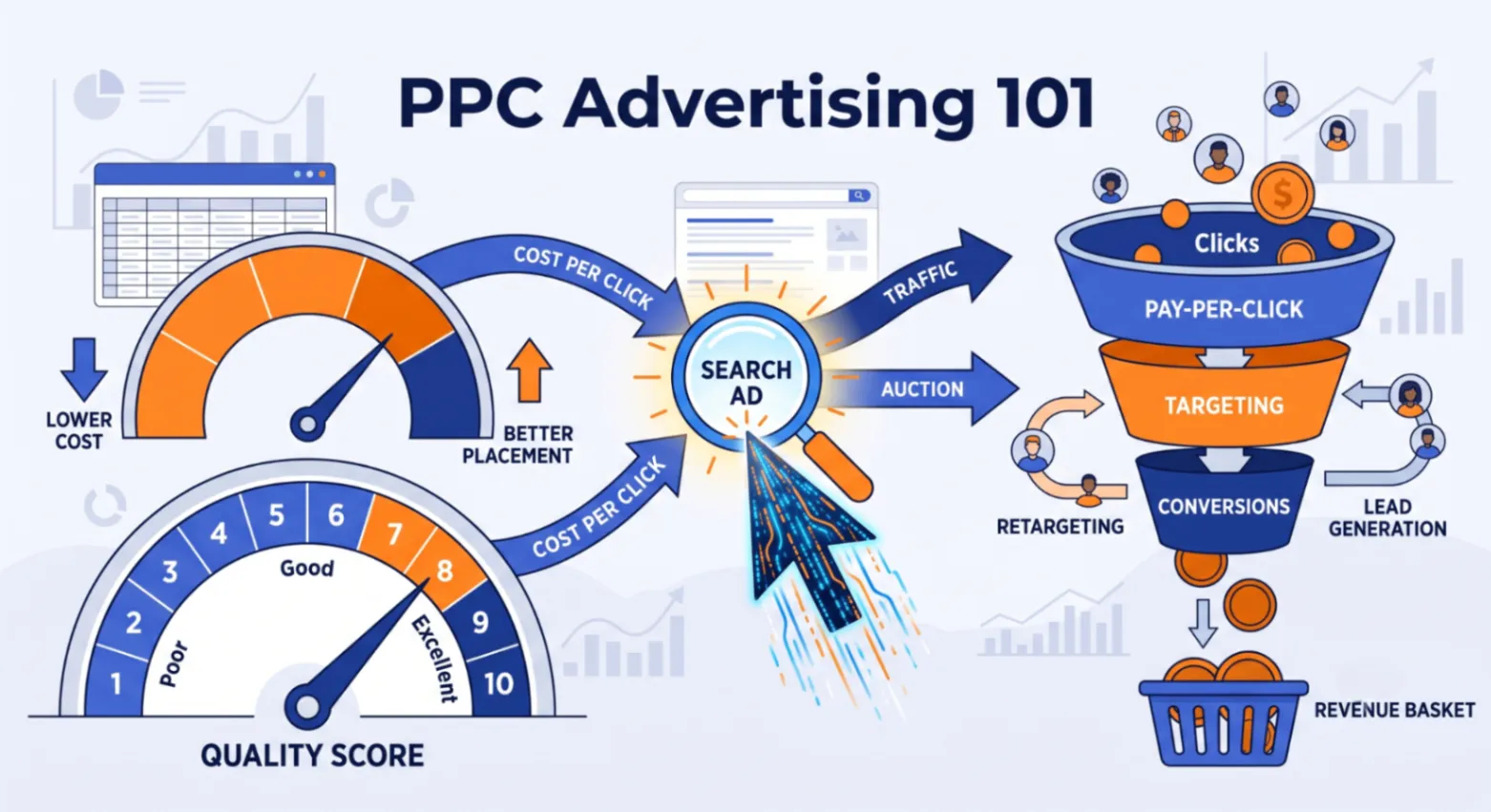
Pay-per-click advertising charges you each time someone clicks your ad, not for the placement itself. It runs on the CPC pricing model, and it remains the most direct way to put a specific, intent-driven audience in front of a landing page — because you only pay when a targeted user acts on the ad. For where paid clicks sit in the wider funnel, see our complete guide to performance marketing and lead generation.
Where PPC Sits in the Funnel
PPC is the CPC leg of the three performance marketing models, sitting between CPM's focus on visibility and CPA's focus on completed actions. You reach for it when the goal is qualified traffic — getting the right people onto a page as a step toward a conversion you will close there or later.
What Actually Determines the Cost of a Click
Click costs are set by auction. Advertisers bid for placement against a keyword or audience, and the winning cost reflects competition, commercial intent, and ad quality. This is why the same word can cost pennies in one industry and tens of dollars in another — a click on "personal injury lawyer" and a click on "free recipe blog" are priced by very different demand.
Quality Score: The Lever Most Advertisers Ignore
Here is the part that separates people who run PPC from people who understand it. Most platforms do not simply award placement to the highest bid. Google Ads, for example, uses a Quality Score (rated 1–10) built from three components: expected click-through rate, ad relevance, and landing page experience.
A higher Quality Score buys you better placement at a lower cost. In practice, a well-optimized advertiser with a Quality Score of 8 can win a spot that a competitor with a score of 4 has to outbid — sometimes paying meaningfully less per click for the same position. That makes ad copy and landing page quality direct cost-control levers, not creative afterthoughts.
- Expected Click-Through Rate (CTR): How likely users are to click your ad.
- Ad Relevance: How closely your ad matches the user's search intent.
- Landing Page Experience: How useful, fast, and easy-to-navigate your page is.
Load speed feeds this loop twice: a slow page suppresses conversions and drags down landing page experience, raising the cost to hold placement. Fixing speed pays off on both sides at once.
Clicks Are Not Results
A campaign can pile up clicks and still lose money if those clicks do not convert. Conversion rate optimization matters as much as targeting and bidding — driving traffic is half the job, and the landing experience decides how much of it becomes business. For many advertisers, PPC exists specifically to feed a lead generation funnel, so the click is only the entry point.
Targeting Fundamentals — Including the Negative
Effective PPC starts with the right keywords or audience segments, chosen for genuine commercial intent rather than raw volume. The under-discussed half is negative keyword targeting: explicitly excluding terms that generate clicks that never convert. A plumber bidding on "plumber" without excluding "plumber salary" and "plumber apprenticeship" is paying to reach people who will never buy. Negative lists are where a lot of quiet waste gets recovered.
Search Intent Shapes Everything
Queries reveal where a buyer is. "How does CPA marketing work" is early-stage research; "CPA agency pricing" is close to a decision. Structuring campaigns around this intent spectrum — different messaging and offers for each stage — consistently beats treating all traffic as equivalent. It is also why B2B PPC works differently: business purchases involve longer consideration and multiple decision-makers, which our B2B guide covers in depth.
Retargeting: PPC's Highest-Efficiency Extension
Retargeting shows ads to people who already visited without converting. Because those audiences have demonstrated interest, retargeting typically converts higher and costs less than prospecting to strangers. For most advertisers it is the single most efficient slice of a PPC program — and one of the first places to look when you need results without a bigger budget.
Budget Mistakes and Account Structure
The most common budget error is spreading spend too thin across too many keywords, so no single segment gathers enough data for the platform's optimization to work. Concentrate budget on a smaller, well-targeted set first, then expand as data accumulates. Structure matters here too: group tightly themed keywords and ads together rather than mixing unrelated topics, which improves relevance scores and makes the account manageable as it grows. Marketing automation takes over the routine bid adjustments once you are managing many segments at once.
Test, but Give It Time
Run multiple ad variations, then let each accumulate enough clicks before declaring a winner. Calling a variation early, on a handful of conversions, is how teams lock in a "winner" that was really just noise. Done patiently, this testing reveals messaging patterns you can reuse well beyond paid search — in landing pages, sales collateral, even product positioning. PPC's fast feedback makes it one of the best audience-research tools you have, not just a traffic source.
Device and Location
PPC platforms let you refine by device and geography, and both can swing performance hard. A local service business should tighten geographic targeting aggressively; an e-commerce brand may want broad reach with device bids tuned to where conversions actually land. Match these settings to where your customers really are, not to the platform's defaults.
The Bottom Line
PPC, built on CPC pricing, is one of the most effective ways to buy targeted, intent-driven traffic — but bidding is the smallest part of doing it well. Targeting, negative keywords, Quality Score, landing page conversion, and disciplined testing decide whether clicks become customers. Learn more about our CPC campaign services to see how a structured PPC approach fits a broader performance strategy.
Ready to put this into practice? Contact 47 Yards to build a performance marketing strategy around your business.