What Is Performance Marketing? A Complete Guide for Businesses
Author: Richa Naik, Digital Marketing Manager
Date : 5 August 2026
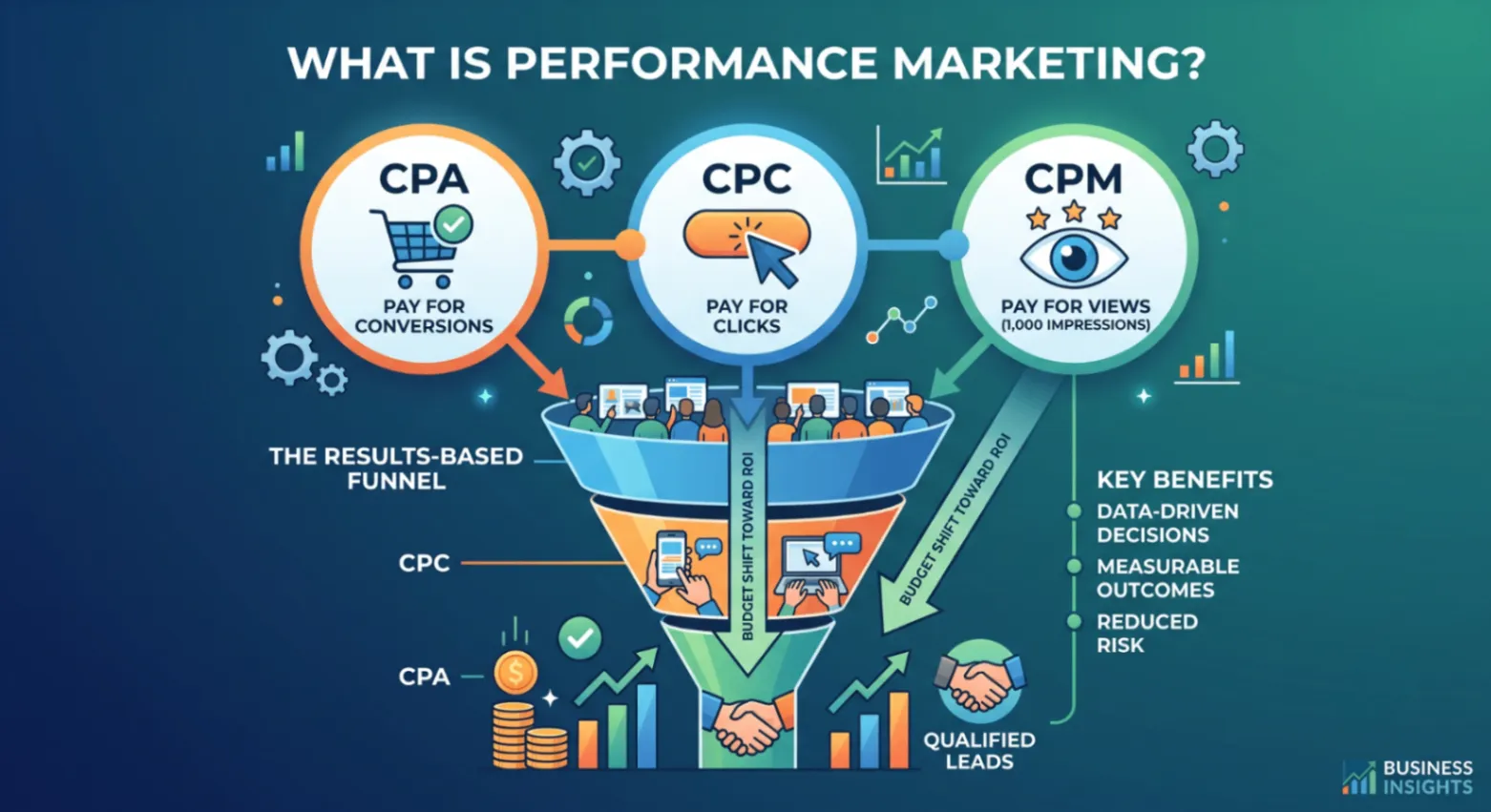
Performance marketing is advertising you pay for by result — a completed sign-up, a click, or a block of impressions — instead of a flat fee for placement. The distinction sounds small. In practice it changes who carries the risk when a campaign underperforms, and it changes how a finance team judges whether marketing is working at all. This article is part of our complete guide to performance marketing and lead generation, which maps how every piece fits together.
Defining Performance Marketing
Traditional brand advertising buys exposure: airtime, a billboard, a magazine spread. You pay whether or not anyone acts. Performance marketing exists to close the gap between spend and outcome by tying the invoice to something measurable. That is why it has taken share from flat-fee media — it gives the people signing off on budget a direct line from dollars out to results in.
The Three Core Pricing Models
Nearly every performance campaign runs on one of three pricing structures, and each answers a different question.
CPA marketing charges only when a defined action completes — a purchase, a form submission, a trial sign-up. It is the most accountable of the three and the natural fit when you know exactly what a conversion is worth.
CPC, covered in our PPC guide, charges per click and suits traffic-driven goals where the click is the first step toward a conversion you will close elsewhere.
CPM advertising charges per thousand impressions and suits awareness goals where being seen matters more than an immediate click.
One caveat worth stating plainly: CPA shifts risk toward the party running the campaign, but CPC and CPM do not. Under CPC you pay for every click whether or not it converts; under CPM you pay for impressions regardless of engagement. "Performance" does not mean "risk-free" — it means "measurable."
Why Budget Is Moving Toward Performance Models
For decades, marketing budgets were defended with a mix of brand metrics and instinct, and nobody could say with confidence what a given dollar produced. Better tracking changed the conversation. Conversion pixels, server-side tracking, and modern attribution now connect a specific ad to a specific outcome with precision that was impractical a decade ago. Once that visibility existed, advertisers demanded pricing that reflected it — and platforms built campaign types around measurable actions rather than airtime.
How Lead Generation Fits In
Lead generation is one of the most common jobs performance marketing is hired to do, because a qualified lead is a directly measurable outcome. Our guide to lead generation strategies that convert covers the tactics for turning campaign traffic into leads a sales team can actually use — the difference between volume and value, which is where most lead programs quietly leak money.
Measure Past the First Click
The most common measurement mistake is stopping at the first available number — clicks, impressions, initial sign-ups — instead of following the funnel to a completed sale or qualified conversation. Customer acquisition cost is the downstream metric that ties upstream activity to the real cost of a paying customer, which is what the business actually cares about. And once traffic is arriving, conversion rate optimization is the next lever — a well-targeted campaign still fails if the landing page cannot convert the audience it attracts.
How Attribution Differs Across the Three Models
Each model is judged differently, and comparing them on the wrong axis produces nonsense conclusions.
CPM is evaluated on reach and frequency from the serving platform. CPC relies on click tracking tied to specific placements. CPA needs full-funnel tracking — an ad exposure connected all the way to a completed action on your own site, usually via conversion pixels or server-side events. Comparing a CPM campaign's reach against a CPA campaign's conversions, without accounting for what each measures, is like comparing a speedometer to an odometer.
Where Automation Fits
Once campaigns run across multiple channels and pricing models at once, manual management stops scaling. Marketing automation handles the repetitive optimization and follow-up so campaign managers spend their time on strategy instead of manual bid tweaks.
Choosing the Right Mix
Few businesses live on a single model. A typical blend uses CPM for top-of-funnel visibility, CPC to pull qualified traffic, and CPA to convert that traffic into measurable actions — each doing the job it does best. Working with a partner fluent across all three, rather than a specialist in one, lets you run that blended strategy without juggling several vendor relationships and stitching their reports together by hand.
Common Mistakes When Adopting Performance Marketing
Two errors show up again and again. The first is expecting dramatic results in week one, before the platform's targeting has left its learning phase — most campaigns need a stabilization period before their numbers mean anything, and judging them on three days of data usually leads to killing something that was about to work. The second is treating one model as inherently "better" — assuming CPA beats CPC because it feels lower-risk — without asking which stage of the funnel you are actually trying to influence.
Setting Realistic Expectations for a First Campaign
Treat an initial campaign as a data-gathering exercise, not a verdict. The goal in the first few weeks is learning what works — which audiences, which creative, which offers — not fully optimized output. Businesses that frame early data this way consistently end up with better long-run results than those that expected a finished machine on day one.
When to Bring In a Specialist
The tipping point is usually complexity, not budget. When you are running several campaigns across different models and platforms — juggling targeting, budgets, creative testing, and attribution alongside a day job — the coordination cost exceeds what a small in-house team can carry well. That is typically the moment a specialist partner becomes more practical than another internal hire.
The Bottom Line
Performance marketing gives you a clear line between spend and result, using CPA, CPC, and CPM to match pricing to the goal. Getting value from it takes patience through the learning phase, honesty about which model fits which stage of the funnel, and attention to the full funnel rather than a single flattering top-line number. Explore our full range of performance marketing services to see how the three models can work together for your business.
Ready to put this into practice? Contact 47 Yards to build a performance marketing strategy around your business.