Customer Acquisition Cost: What It Is and How to Lower It
Author: Richa Naik, Digital Marketing Manager
Date : 15 September 2026
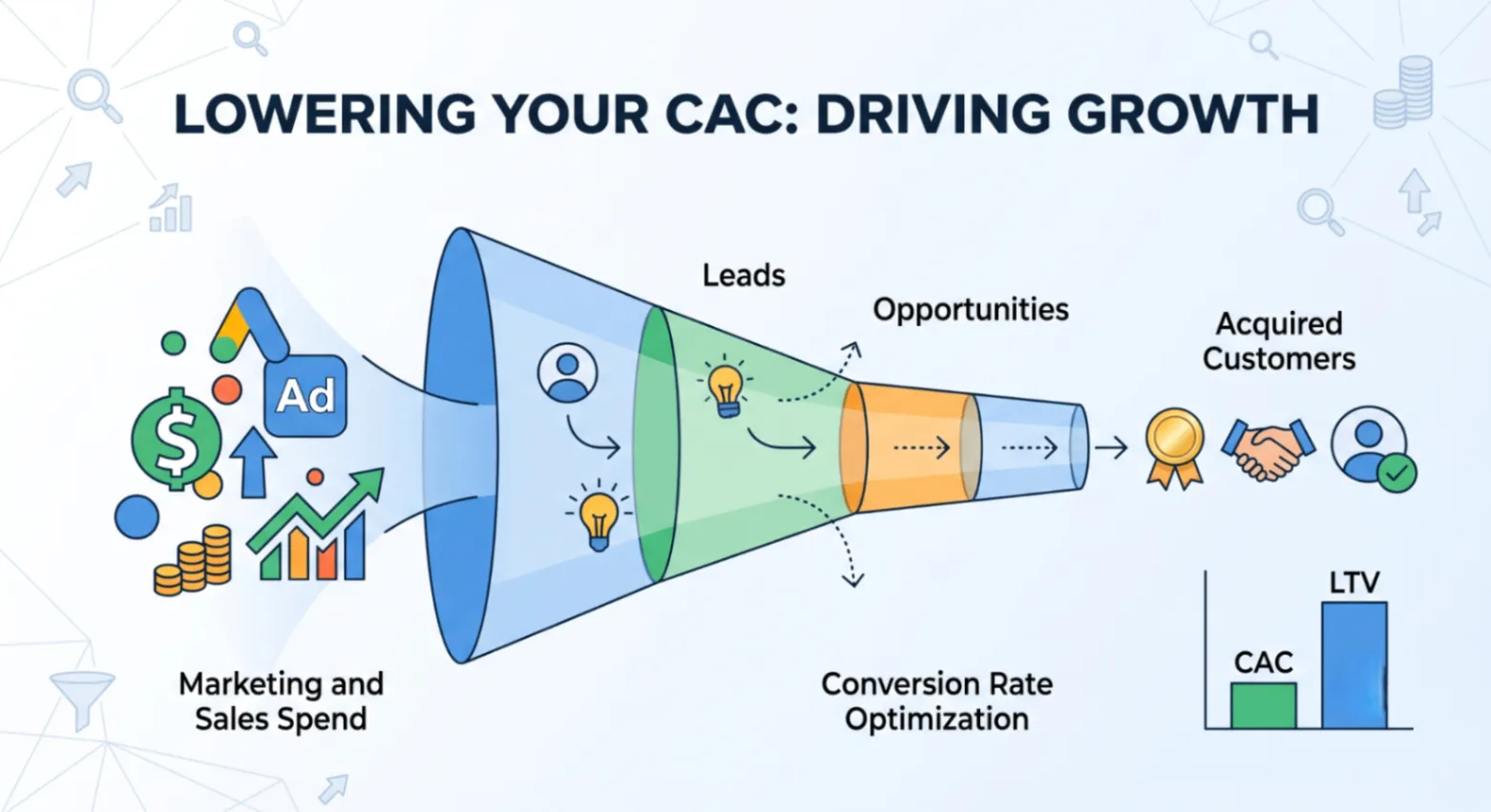
Customer acquisition cost is the total cost of winning one paying customer. It is the number that tells you whether marketing is a growth engine or an expensive habit — and it is more honest than ad spend or cost-per-lead, because it counts the full cost of turning activity into an actual paying relationship. For how CAC ties the whole funnel together, see our complete guide to performance marketing and lead generation.
How to Calculate It — Properly
The basic formula is simple; doing it accurately is where people slip.
Take all relevant marketing and sales costs over a period and divide by new customers acquired in that period. Say you spent $40,000 and gained 50 customers: a naive CAC is $800. But if you left out $15,000 in loaded salary time for the sales and marketing people who did the work, plus tooling and platform fees, your real CAC is closer to $1,100. The gap between those two numbers is the difference between a campaign you think is profitable and one that actually is.
Include direct ad spend, the relevant portion of staff time, and the tools that directly support acquisition. Exclude costs unrelated to winning customers — support for existing customers, for instance — and apply the same definition every period so the number stays comparable.
Why CAC Beats Cost-Per-Lead
A campaign that generates cheap leads is not a good investment if almost none of them close. CAC catches this by measuring against real customers rather than an intermediate metric like cost per completed lead action. Optimize purely for lead cost, without tracking through to conversion, and you can happily drive a metric that has nothing to do with business performance.
CAC Only Means Something Next to Customer Value
CAC in isolation is neither good nor bad — it has to be weighed against what a customer is worth over their lifetime.
A common benchmark for subscription and SaaS businesses is an LTV:CAC ratio around 3:1 — a customer worth roughly three times what it cost to acquire them. Below that and margins get thin; well above it and you may be underinvesting in growth. Pair the ratio with payback period — how long a customer's revenue takes to repay their acquisition cost. A healthy 3:1 ratio can still strain cash flow if payback takes eighteen months and you are short on capital.
Treat these as directional benchmarks, not laws — they vary by model and margin — but tracking your own trend over time beats chasing industry averages that reflect very different businesses.
The Fastest Lever: Conversion Rate
The most direct way to lower CAC without cutting spend is raising conversion at each funnel stage. Conversion rate optimization reduces how many visitors or leads you need per customer, which lowers effective acquisition cost even when traffic and lead costs are unchanged. Improving a page from 2% to 4% does not just help the campaign — it halves the traffic required to hit the same customer count.
The Model Mix and the Follow-Up
Blending CPM awareness with direct CPC and CPA usually lowers overall CAC versus pure direct-response, because brand-familiar audiences convert more efficiently — one more reason a full-funnel approach beats a single-model one on cost.
Follow-up matters just as much: leads contacted promptly and consistently convert at meaningfully higher rates, so marketing automation that guarantees consistent follow-up regardless of volume directly improves the lead-to-customer rate that decides CAC.
Segment It, Don't Blend It
A single blended CAC hides which channels are carrying the business and which are dragging it down. Calculate CAC separately by channel and campaign, and the efficient growth engines and the money-losers both become visible. Track it over an attribution window that matches your sales cycle, too — especially for B2B, where a short window makes long-cycle campaigns look worse than they are.
Practical Steps You Can Take This Quarter
Near-term CAC wins rarely require new campaigns. Audit conversion rates on your key landing pages; review how fast and consistently leads get followed up; and break CAC out by channel to spot anything clearly underperforming enough to pause or restructure. These cost far less than launching something new and usually move the number faster.
Read CAC as an Early Warning System
A sudden, unexplained CAC rise across multiple channels at once is often more than a marketing problem — it can signal rising competition, a market shift, or weakening product-market fit. Treat an unusual trend as a prompt to investigate broadly rather than assuming the cause is always ad execution. And make CAC a shared, cross-functional metric: it is shaped by marketing, sales, and even pricing, so owning it inside marketing alone limits how well the whole business can address it.
When CAC rises temporarily as part of a deliberate scaling push, say so — a raw number presented without context invites premature budget cuts based on a metric shift that does not reflect the strategy. Providing the reasoning alongside the figure keeps stakeholders informed and support intact.
The Bottom Line
CAC gives a truer picture of marketing efficiency than cost-per-lead or cost-per-click, because it measures against paying customers. Lower it sustainably by raising conversion rates, blending models across the funnel, ensuring fast consistent follow-up, and tracking accurately by channel over the right window — not by slashing spend, which often raises CAC by removing the volume that kept campaigns efficient. Explore our full-funnel strategy to see how it could lower your customer acquisition cost.
Ready to put this into practice? Contact 47 Yards to build a performance marketing strategy around your business.