What Is Digital Marketing? A Complete Guide to How Every Channel Works Together
Author: Richa Naik, Digital Marketing Manager
Date : 15 September 2026
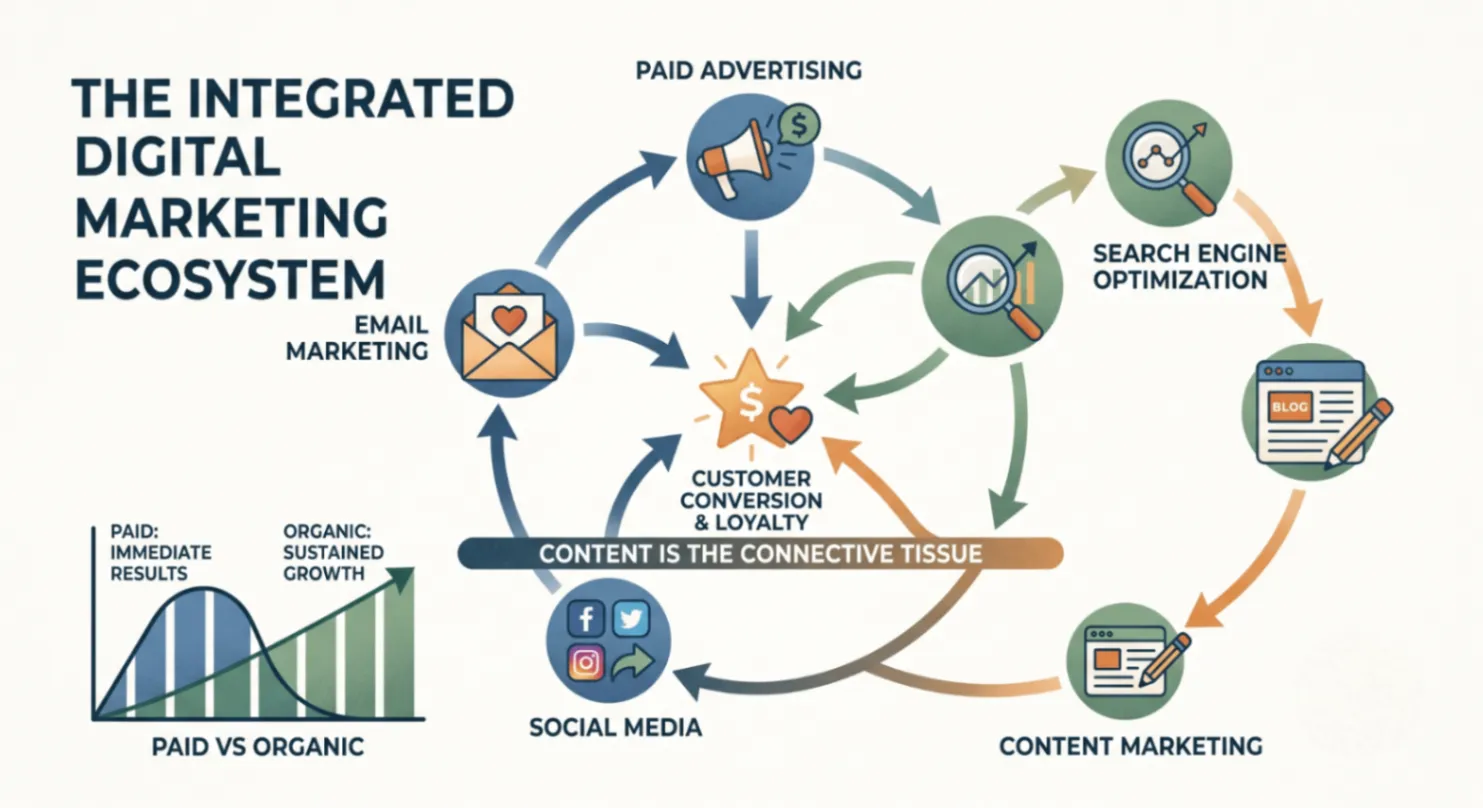
"Digital marketing" gets used so broadly it can stop meaning anything. For a business deciding where to spend, the useful move is to break it into its parts and see how they connect — because the channels are not competitors fighting over one budget, they are stages of one system for turning attention into customers.
Digital Marketing as an Umbrella
At its broadest, digital marketing is any marketing through digital channels: search, social, email, websites, and paid platforms. Underneath sit distinct disciplines, each with its own timeline and measurement. The core five most businesses build around are paid advertising, search engine optimization, content marketing, social media, and email. Understanding how each contributes is the difference between a coherent strategy and a scattered pile of tactics.
The Fundamental Split: Paid vs. Organic
The first distinction that matters is paid versus organic. Paid — search ads, social ads, display — buys visibility directly; results arrive fast and stop the moment spend stops. That is the territory of our performance marketing guide, where CPA, CPC, and CPM each buy a different outcome. Organic — SEO, content, organic social — earns visibility through relevance and authority over time. It builds slowly but compounds and persists without continuous spend.
The two are complements, not substitutes: paid captures demand today, organic lowers your cost of capturing it tomorrow.
Content Is the Connective Tissue
Content sits underneath almost every channel, labeled or not. The landing pages paid campaigns drive to are content. The posts that build an organic following are content. The articles that earn rankings are content. Rather than a separate function, content is the material every other channel depends on to communicate value once the audience arrives.
Email: The One Channel You Own
Of every channel, email is unique: you own the audience relationship instead of renting attention on a platform someone else controls. A list built through your other channels becomes a durable asset immune to algorithm changes and rising ad costs — which is why email so often quietly outperforms flashier channels on return.
How the Channels Compound
In a well-run strategy the channels rarely operate alone. A prospect meets you through a paid social ad, later finds your blog in organic search, joins your email list after reading it, and converts when a retargeting ad reminds them. That is the multi-touch journey behind our lead generation guide — and the reason single-channel attribution misleads.
Build the Mix Around Your Business, Not the Trend
Not every channel deserves equal investment. A B2B firm selling a high-consideration service usually gets more from content, SEO, and email nurture, given long cycles and multiple decision-makers; for a small set of especially high-value accounts, an account-based approach concentrates that effort even further. A consumer brand selling an impulse product often gets faster value from paid social and PPC, where the path to purchase is short. Understanding your own sales cycle and buyer behavior — not copying whatever mix is fashionable — is what separates a real strategy from borrowed tactics.
Where to Start From Scratch
Build the owned assets first: a website that converts and an email capture mechanism, before layering paid traffic on top. Paid campaigns sending traffic to a site that cannot convert are spending money to expose a conversion problem, not solve it — which is why conversion rate optimization belongs early, not as an afterthought. Then add one or two channels that fit your audience, prove them, and expand. Launching everything at once makes it nearly impossible to tell which channel drove which result.
The Bottom Line
Digital marketing is not one activity — it is a set of channels with different timelines, costs, and roles that work best coordinated around a shared strategy and a shared view of the data underneath. Get the paid-versus-organic logic, the role of content, and cross-channel measurement right, and you build a presence that compounds instead of restarting with every campaign. Explore our services to see how these channels come together for your business.
Ready to put this into practice? Contact 47 Yards to build a digital marketing strategy around your business.