Content Marketing Explained: How to Build an Audience That Converts Into Leads
Author: Richa Naik, Digital Marketing Manager
Date : 15 September 2026
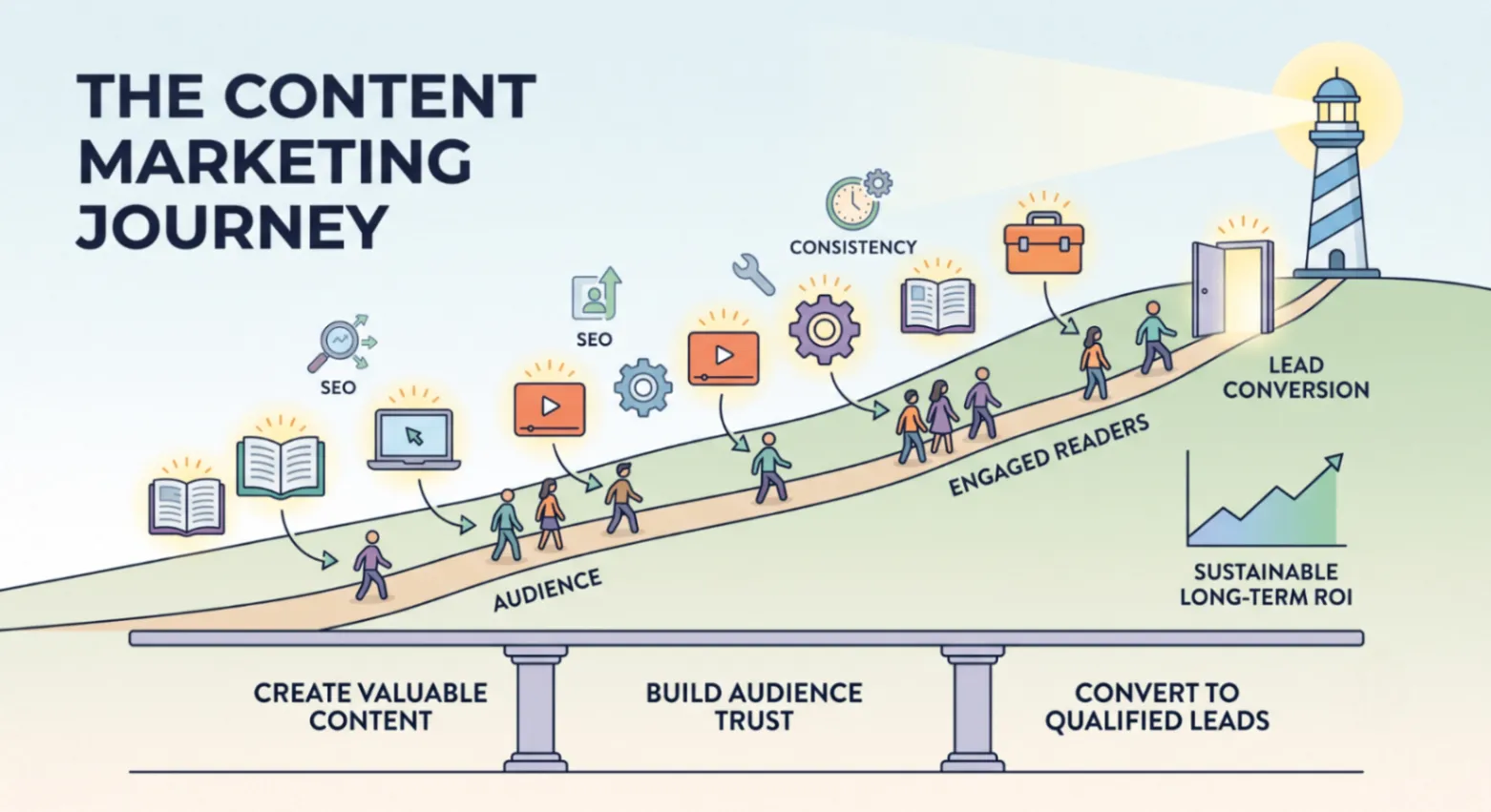
Content marketing is a patience play, and that is exactly why it is misunderstood. It does not spike a dashboard the week you publish. It builds an audience and a search footprint that keep producing leads long after the work is done — the opposite economics of paid, where results stop when spend stops.
What It Actually Is
Content marketing means creating material — articles, guides, videos, tools — that earns attention by being useful, then converts that attention into a business relationship. The trap is producing content that impresses peers but never connects to a commercial outcome. Every piece should have a job: rank for a query, answer an objection, move someone one step closer to buying.
It Runs on a Different Clock Than Paid
A paid campaign can show ROI in days. A content program is better measured in quarters, because rankings, subscribers, and authority accrue slowly and then compound. This is the most common reason content efforts get killed: judged on a paid timeline, they look like failures right up until the point they start outperforming paid on cost. Set the expectation before you start, not after.
Write for the Buyer's Journey
Map content to where the reader is. Early-stage pieces answer broad questions and build trust; middle-stage pieces compare approaches; late-stage pieces address pricing, objections, and proof. A library that is all top-of-funnel builds traffic that never converts; one that is all bottom-of-funnel has nothing to attract an audience in the first place. Balance across the journey is what turns readers into leads.
Turn Readers Into Leads
Traffic that never converts is a vanity metric. Give each piece a relevant next step — a downloadable resource, a tool, a consultation offer — matched to the reader's stage, and support it with conversion-focused pages. A high-value, specific offer pulls fewer but better leads than a generic "subscribe"; test offers against downstream close rate, not sign-up count.
Content and SEO Are Not the Same Thing
They are partners, not synonyms. SEO is how content gets found; content is what SEO ranks. Content written with no regard for search never surfaces; content written only for algorithms reads like it and converts poorly. The work is producing something genuinely useful and making it discoverable — both, not either.
Consistency Beats Volume
One strong piece a month, sustained for a year, outperforms a burst of twenty followed by silence. Search engines and audiences both reward reliability, and a sustainable cadence you can actually maintain beats an ambitious one you abandon after six weeks. Build an editorial process — planning, drafting, review, publishing — that runs regardless of how busy the team gets, and lean on marketing automation to distribute and nurture without manual effort each time.
Maintain What You Publish
Content is not "publish and forget." Your best-performing articles decay as facts age and competitors improve. A quarterly pass to refresh, update, and expand the top pieces often returns more than writing new ones from zero, because you are compounding assets that already have authority and rankings rather than starting cold.
Where This Fits
Content is the layer that makes every other channel work: it feeds SEO, gives social something worth sharing, and gives email something worth sending — the connective tissue of your broader digital marketing effort. Treated as a compounding asset rather than a stream of disposable posts, it steadily lowers what you pay to acquire each customer.
Ready to put this into practice? Get in touch to build a content program aimed at leads, not just traffic.