CPA Payout Rules: How to Set a Payout, Define a Valid Action, and Stop Disputes Before They Start
Author: Richa Naik, Digital Marketing Manager
Date : 2 November 2026
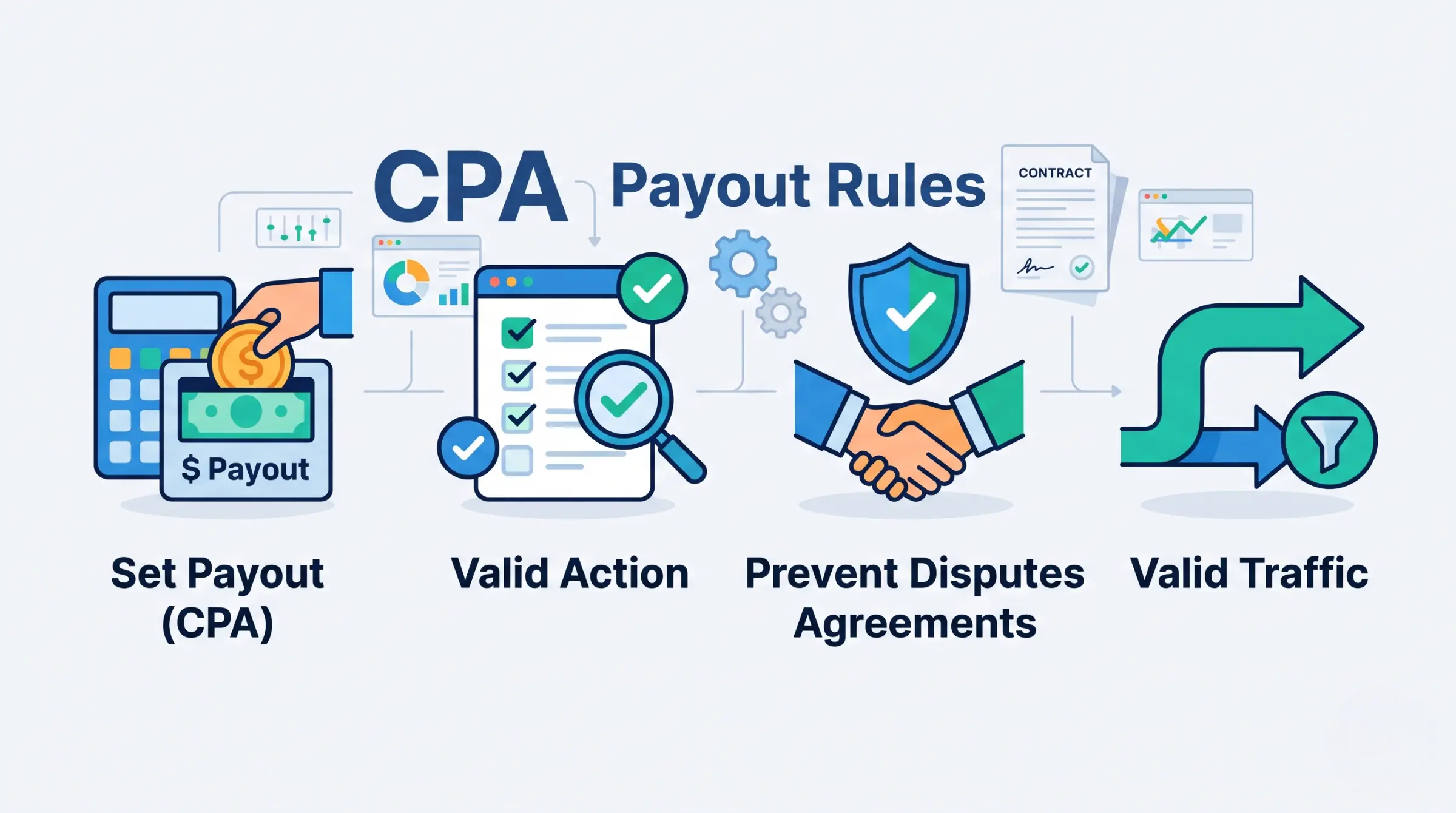
Paying only when something happens sounds simple. The complication is deciding what counts as "something", who confirms it, and how much it is worth. Most disputes between advertisers and partners are not about effort. They come from a payout term that nobody wrote down clearly.
This article is a working guide to the agreement itself: how to calculate a payout ceiling, how to define a valid action, how to handle validation and reversals, and how to screen for low-quality or fraudulent traffic. It assumes you already know what a cost-per-action model is. If you want the basics first, read our explainer on CPA marketing and how action-based campaigns work. Here the subject is the paperwork and the maths behind it.
Start With a Payout Ceiling, Not a Payout Request
Partners will tell you what other advertisers pay. That number describes their other deals, not your economics. Work out your own ceiling first.
The ceiling for one paid action is the gross profit per customer, multiplied by the share of those actions that become customers, multiplied by the share of that expected profit you are willing to hand to the partner.
Illustrative example. A services company earns $1,200 in gross profit per customer. Of the leads a partner sends, about one in ten becomes a customer. The expected gross profit per lead is therefore $120. The company wants to keep at least half to cover sales time, overhead, and margin, so the payout ceiling is $60 per lead.
Now suppose a second partner's leads close at one in twenty. The expected gross profit per lead is $60, and the ceiling falls to $30. The same action is worth different amounts depending on where it came from. That is the strongest argument for paying on a validated action, or for tiering payouts by quality, instead of agreeing one flat price for every source.
Use your own close rates. If you do not have them yet, start with a small capped pilot and calibrate the payout once outcomes mature. Our guide to defining and scoring a qualified lead shows how to build that data.
Decide Exactly Which Action You Are Paying For
Actions sit on a ladder, and each rung moves risk between you and the partner.
- Registration or raw form fill: easy for the partner to deliver, easiest to fake, and weakly linked to revenue.
- Verified lead: contact details confirmed, location and basic fit checked.
- Qualified lead: meets written fit and intent rules, as agreed in advance.
- Kept appointment or completed trial: the person showed up or used the product.
- Sale: the strongest signal, but the slowest, and the hardest for a partner to forecast or influence.
Earlier rungs bring more volume and more risk for the advertiser. Later rungs protect the advertiser and push forecasting risk onto the partner, who may then demand a higher payout or walk away. There is no correct rung, only one that matches how well you can verify outcomes.
Whichever you choose, define the action in terms that a system can test. A usable definition lists the required fields, the accepted geography, the verification step, the uniqueness rule, and the exclusions. For example:
- All required fields are complete and the phone number or email passes verification.
- The person is inside the service area stated in the offer.
- The record is unique: the same person has not been submitted by any partner in the last 90 days.
- The person is not an existing customer or an open opportunity.
- Consent wording was shown at the point of capture and is stored with a timestamp. If a partner collects the lead, you stay responsible for how consent was obtained, so ask to see the page and wording (see our guide to consent and data handling in lead generation).
If a record fails any line, it is not billable. Writing it this way removes arguments about opinion.
Set a Validation Window and a Reversal Process
Few actions can be judged the moment they arrive. Agree on a validation window, which is the period in which you may check records before you owe payment. Keep it as short as your process allows, because partners fund their traffic in advance and long delays damage trust.
Agree the reasons a paid action can be reversed, and list them. Typical reasons include duplicate records, invalid contact details, out-of-area leads, existing customers, evidence of automated or incentivized submissions, and missing consent evidence. A reason that is not on the list should not be a reason to refuse payment.
Commit to two service levels of your own: how quickly you will review a batch, and how quickly you will tell the partner why a record was rejected. Partners can improve only when they see reasons. A rejection with no explanation is a source of resentment, and in practice a source of lost partners.
Provide a dispute route. The partner submits the record and its evidence, you review within a set number of days, and a named person decides. Keep a log of disputes. If the same reason recurs, the definition is unclear and needs rewording.
Know the Common Low-Quality and Fraud Patterns
Most partners are honest, but any model that pays per event attracts some who game it. Watch for these signs:
- Many records sharing a device, address, or network signature
- Bursts of submissions at unusual hours or in perfectly even intervals
- Contact details that follow a pattern, such as sequential numbers or disposable email domains
- Submissions completed far faster than a person could fill in the form
- Click identifiers that do not match any recorded ad click
- Traffic sources that differ from those approved in the agreement, such as incentivized or pop-up traffic where it is banned
- Brand-term bidding or use of your trademarks where the agreement forbids it
None of these proves fraud on its own. Together they justify a closer look. Controls that work well include email or phone verification, double confirmation, uniqueness checks across partners, minimum time-on-form thresholds, an approved list of traffic sources, and call or message sampling where a human reviews a handful of leads each week. Set caps by day and by month so that a sudden spike cannot create a large bill before anyone looks.
Choose a Payout Structure That Rewards Quality
You have four common options.
- Flat payout: simple to explain, but it pays the same for good and poor leads.
- Tiered payout: the rate depends on a quality measure, such as the share of leads accepted or the qualified rate.
- Base plus bonus: a lower fixed amount for each valid action, with a bonus when quality or volume passes agreed thresholds.
- Revenue share: the partner earns a share of profit from customers produced. It aligns interests, but needs long, trustworthy tracking.
Illustrative example. A partner is paid $40 per valid lead, plus a $15 bonus for each lead that reaches the qualified stage. The advertiser's ceiling for a qualified lead is $90. A partner whose leads are mostly qualified costs $55 per qualified lead at best, while a partner whose leads rarely qualify earns close to the base rate and gains little from the bonus. The structure steers effort toward the outcome you want without a single judgment call.
Whatever you choose, test the maths against your ceiling at both the best and worst expected quality, not only at the average.
Clauses That Belong in the Agreement
A short agreement written in plain language beats a long one nobody reads. Include these clauses:
- The definition of the paid action, exactly as above.
- The payout amount or structure, and the currency and payment schedule.
- The validation window and the permitted reasons for reversal.
- Approved traffic sources and prohibited practices.
- Required evidence of consent and the right to inspect it.
- Caps by day or month, and who may change them.
- Reporting access and the system of record for disputes.
- The right to pause or end the arrangement, and what happens to pending payments.
- Data handling terms for any personal data the partner collects on your behalf.
Have a lawyer review the final text, particularly for data protection and any sector-specific rules.
Track and Reconcile on Data You Control
Payment disputes frequently turn out to be tracking disputes. Decide in advance which system decides whether an action happened. For lead programs, that is usually your CRM, with the partner's own reporting used for comparison.
Make sure each record arrives with a partner identifier, a campaign or sub-source field, and a click identifier, as described in our conversion tracking audit checklist. Reconcile weekly. Small differences are normal, and large gaps should be explained before the invoice cycle, not after it. Give partners read access to their own accepted and rejected records so they can reconcile independently.
Launch Small, Then Review Monthly
Begin each new partner with a capped pilot and a clear learning goal. Review accepted rate, qualified rate, cost per qualified lead, and complaint volume against your ceiling. Keep a one-page scorecard per partner, and use it to decide whether to raise caps, change the structure, or end the arrangement. If you also run paid media yourself, compare partner results with your own channels using the performance marketing KPIs by funnel stage. For help structuring partner programs, our performance marketing services cover agreement setup and reporting.
Mistakes That Cause Most Disputes
- Agreeing a payout before calculating the ceiling
- Leaving "valid" undefined or defined only in an email thread
- Applying new rejection reasons after the traffic has already arrived
- Holding payments past the agreed window without explanation
- Trusting partner-reported numbers with no CRM comparison
- Setting no caps in the first month
- Ignoring consent evidence until a complaint arrives
Frequently Asked Questions
What is a fair validation window?
It depends on how long checks take. Choose the shortest window your process can meet reliably and write it down, because predictable payment keeps good partners.
Should I pay for leads or for sales?
Pay on the latest action you can verify without making the partner's forecasting impossible. Many programs pay on a validated or qualified lead and add a bonus for sales.
How do I handle duplicates across partners?
Write a uniqueness rule with a time period, and state who is credited when two partners send the same person, for example the first valid submission.
Key Takeaways
Calculate your own payout ceiling from gross profit and close rate, define the paid action in terms a system can test, agree validation and reversal rules in advance, and reconcile against your CRM. Caps, plain clauses, and a monthly scorecard keep action-based programs fair for both sides.
Ready to put this into practice? Talk to our team about setting payouts and partner agreements for your CPA program.