Lead Quality vs Lead Volume: How to Define, Score, and Report a Qualified Lead
Author: Richa Naik, Digital Marketing Manager
Date : 29 October 2026
Ask a marketing team how the month went and you often hear a lead count. Ask the sales team and you hear that the leads were poor. Both statements can be true. The disagreement usually comes from one missing document: a shared definition of what a good lead is.
This article explains how to define a qualified lead, build a simple scoring model, and report quality alongside volume. It deliberately does not cover funnel design in general, which we address in our lead generation framework. The focus here is narrower: how to decide whether a lead is worth pursuing, and how to prove it with data.
Why Volume Alone Misleads
Volume is easy to count and easy to increase. Lower the price of an offer, shorten the form, or widen targeting, and the number goes up. Quality often goes down with it.
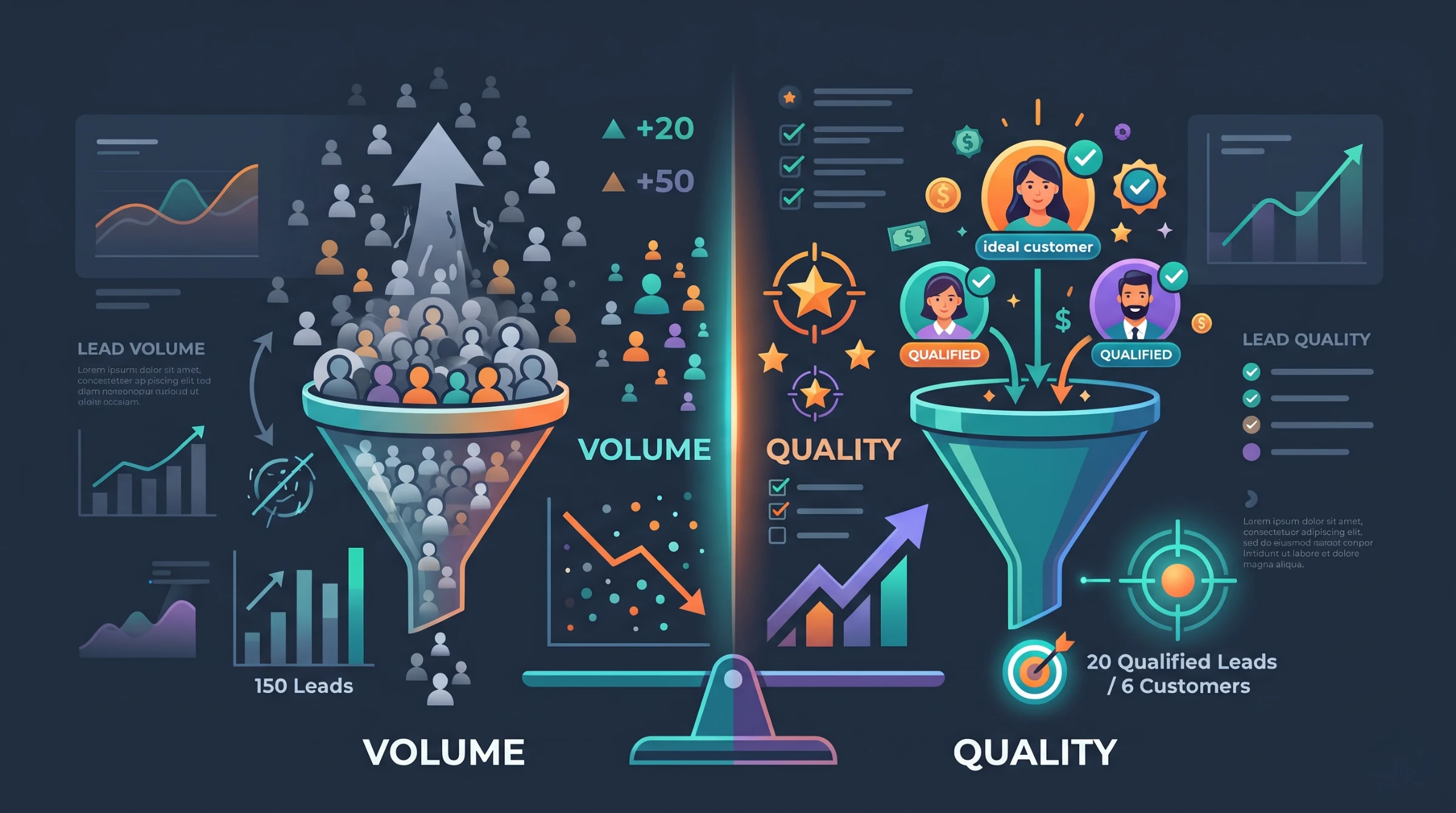
Illustrative example. Two campaigns each spend $3,000 in a month.
- Campaign A produces 150 leads at $20 each. Ten become qualified, and two become customers.
- Campaign B produces 60 leads at $50 each. Twenty become qualified, and six become customers.
Campaign A looks better on cost per lead. Campaign B costs $150 per qualified lead ($3,000 / 20) against $300 for Campaign A ($3,000 / 10), and $500 per customer against $1,500. A report that stops at lead count points you at the wrong campaign.
Defining a Qualified Lead
A qualified lead definition should be short, written down, and agreed by sales and marketing. It usually combines fit and intent.
Fit Criteria
These describe who the lead is:
- Location or service area
- Company size or household type
- Industry or role
- Budget range, where known
- Use case that matches your offer
Intent Criteria
These describe what the lead did or said:
- Requested a quote, demo, or consultation
- Answered qualifying questions on the form
- Visited high-intent pages such as pricing or service detail
- Replied to a follow-up message
Stage Names
Use consistent stage names, and write what each means:
- Lead: any contact record created from a form or call
- Marketing-qualified lead (MQL): meets fit rules and shows minimum intent
- Sales-qualified lead (SQL): sales has spoken with the lead and confirmed need, timing, and authority
- Opportunity: an active deal
- Customer: closed and won
Exact labels vary between companies. What matters is that each stage has an entry rule, and that everyone uses the same one.
Building a Simple Scoring Model
Scoring turns the definition into a number so that sales can prioritize. Start small; a model with eight rules that people trust beats one with fifty that no one reads.
- List attributes from your best existing customers: industry, size, source, behavior before buying.
- Assign points. Give higher points to attributes that appear often in customers and rarely in lost leads.
- Add negative points for disqualifiers such as a personal email address on a business offer, a location outside your service area, or a job title unrelated to purchasing.
- Set a threshold for MQL status.
- Review monthly. Compare scores with outcomes. If high-scoring leads do not close, change the rules.
Use your own closed-won and closed-lost data for this. Industry averages describe other companies' customers, not yours.
Collecting the Data You Need
Scoring requires fields. Capture them at the form and enrich them where practical.
- Add dropdowns for budget band, timeline, or service type if they help qualification and do not suppress completions too much.
- Record source, medium, and campaign on every lead so you can compare quality by channel.
- Log sales outcomes in the CRM using fixed status values, not free-text notes.
Before relying on any of this, confirm that source data survives the journey from ad click to CRM record, using the checks in our conversion tracking audit checklist.
Reporting Quality Alongside Volume
A useful quality report is short. These measures cover most needs:
- Lead-to-MQL rate by source and campaign
- MQL-to-opportunity rate by source and campaign
- Cost per qualified lead (spend divided by qualified leads)
- Cost per customer (spend divided by closed customers)
- Rejection reasons from sales, grouped into categories such as wrong location, no budget, no response, duplicate
Rejection reasons deserve attention. They tell you which targeting, message, or form changes would remove poor leads at the source. A form that attracts students when you sell to businesses can often be fixed with one added question.
For the wider set of metrics and where each belongs, see our guide to performance marketing KPIs by funnel stage.
Feeding Quality Back Into Ad Platforms
If ad platforms only see form fills, they learn to find people who fill forms. Passing qualified-lead or closed-sale events back to the platform helps bidding systems favor the traffic that produces value. Google Ads supports importing offline conversions, and other platforms offer similar connections. This requires a stored click identifier and a reliable CRM process, so treat it as a project, not a toggle.
Where you pay partners per lead, put the qualification rules into the agreement, as described in our guide to CPA marketing, so that rejected leads are not billable.
Speed and Quality Are Linked
A good lead handled slowly becomes a poor outcome. If response times vary widely, quality measures will mix lead quality with sales responsiveness. Track time to first contact alongside conversion, and use the workflows in lead nurturing and speed to lead to make follow-up consistent.
Running a Quality Review With Sales
Hold a monthly 30-minute review with both teams.
- Look at the funnel by source with the report above.
- Sample ten rejected and ten accepted leads and read them together.
- Decide one change to targeting, form, or scoring.
- Record the change and check its effect next month.
This habit builds shared ownership of the definition, which is more valuable than any scoring tool. If you want support designing the definition and reporting, our lead generation services include qualification and reporting setup.
Common Scoring Pitfalls
Scoring models fail in predictable ways.
- Scoring activity instead of intent. Counting email opens or page views can reward curiosity. Weight actions that show buying intent, such as requesting pricing.
- Ignoring decay. A lead that engaged six months ago is not the same as one engaging today. Reduce scores over time.
- Copying another company's model. Their customers differ from yours.
- Hiding the model. If sales cannot see why a lead scored high, they will ignore the score.
- Never testing. Compare score bands with closed outcomes. If the top band closes at the same rate as the middle band, the model is not helping.
Expecting Different Quality From Different Sources
Lead quality usually varies by source, because intent differs. Search leads often reflect stated need, referral leads reflect trust, and cold social leads reflect interest that needs more development. Do not hold every source to the same conversion expectation. Instead, set a quality benchmark for each source from your own history, and compare changes against that benchmark.
Handling Disputed Leads
When sales rejects a lead that marketing considers valid, record the reason and review it together. Sort disputes into three groups: definition problems (the rule is unclear), targeting problems (the wrong people are arriving), and process problems (the lead was good but not handled well). Each group has a different fix, and counting them over time shows which one deserves attention first.
A Short Example of an Agreed Definition
Writing the definition forces precision. A services company might record it like this: an MQL is a contact in the service area, who describes a project with a stated budget band above the minimum, and who has either requested a quote or booked a call. A contact who gives only an email address for a download remains a lead, not an MQL, until they take further action. The sales team then agrees to contact every MQL within one working day and to log an outcome within five. When both sides can quote the same rule, disputes become questions about the rule rather than arguments about opinion.
What to Do When Volume Must Rise
Sometimes the business genuinely needs more leads, for example when capacity is idle or a launch needs momentum. Raise volume deliberately and watch quality. Widen targeting in steps, add a qualifying question to the form to preserve fit, and compare qualified-lead rates before and after each change. If the qualified rate falls sharply, you have found the edge of your efficient audience, and the next growth will cost more per qualified lead.
Frequently Asked Questions
What is the difference between an MQL and an SQL?
An MQL meets marketing's fit and intent rules. An SQL has been vetted by sales and confirmed as a real opportunity. Definitions vary, so write yours down.
Is a higher lead count ever the right goal?
Yes, when you have a reliable way to qualify later, or when the product is low-priced and self-serve. Even then, track what share of leads convert.
How many scoring rules should I start with?
Start with a handful that you can explain in one sentence each. Add rules only when data shows a clear pattern.
Should I pay for leads or qualified leads?
Paying for qualified leads aligns payment with value, but the definition must be precise and verifiable.
Key Takeaways
Lead volume tells you how much activity occurred. Lead quality tells you whether it mattered. Define a qualified lead in writing, score it with your own data, report cost per qualified lead and per customer, and review rejected leads with sales every month.
Ready to put this into practice? Talk to our team about defining, scoring, and reporting qualified leads for your campaigns.