Ad Budget Allocation: How to Split Spend Across Channels and Scale What Works
Author: Richa Naik, Digital Marketing Manager
Date : 30 October 2026
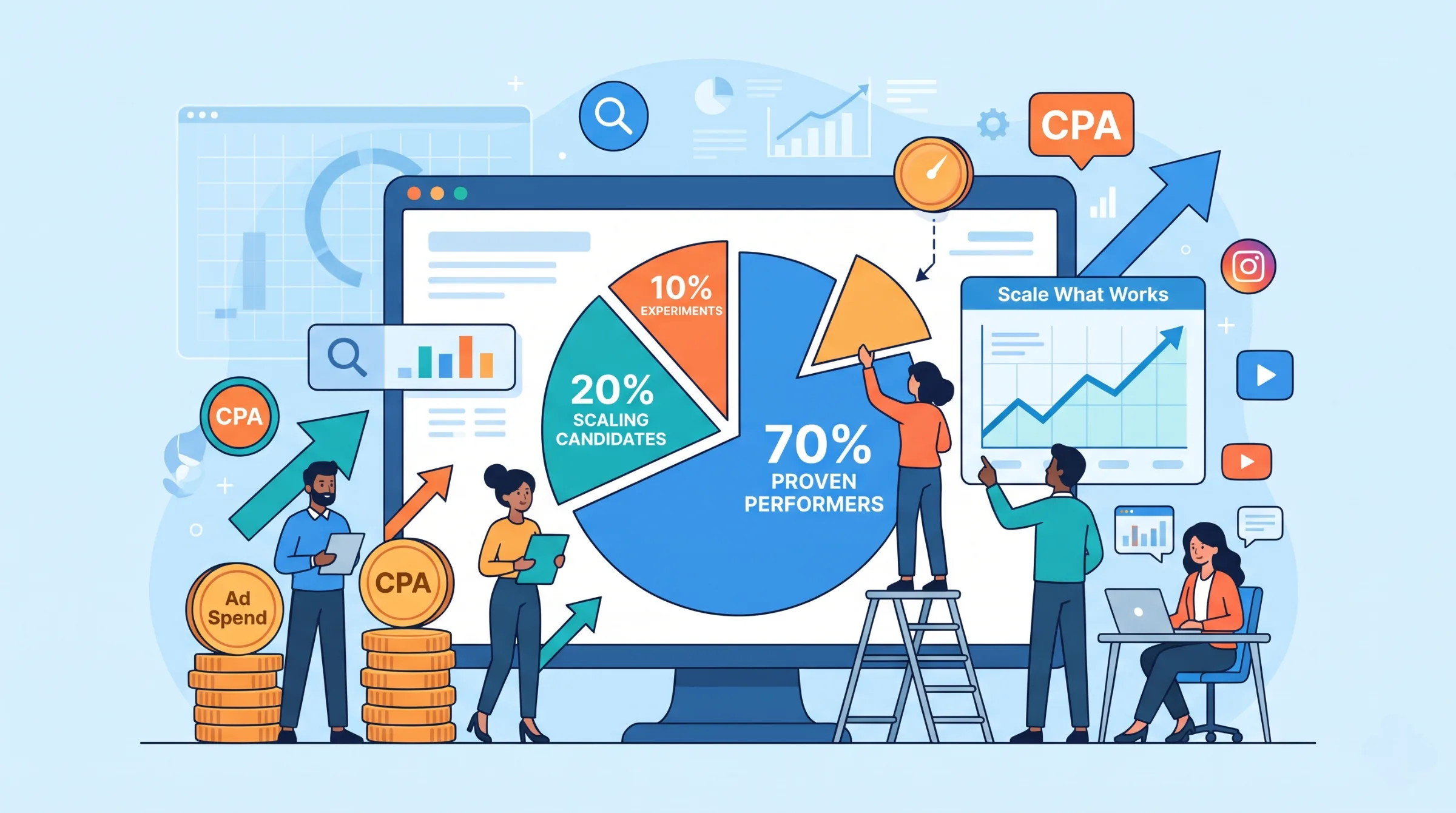
Budget decisions shape results more than most creative or targeting tweaks. Yet many teams set budgets by habit: last quarter's figure plus a bit, divided evenly among whatever channels exist. That approach funds past choices rather than future returns.
This article gives a method for allocating a lead generation budget across channels and campaigns, protecting room for testing, and scaling winners without destroying efficiency. It assumes you can already measure cost per qualified lead; if you cannot, start with the KPI guide and the tracking audit.
Start With the Constraint, Not the Channel
Define three numbers before you split anything.
- Total budget for the period.
- Target cost per qualified lead (or cost per customer), derived from unit economics.
- Required volume of qualified leads to meet the revenue goal.
If the budget divided by the target cost produces fewer leads than you need, you have a planning gap, not an allocation problem. No reshuffling will close it. Either the target cost must fall, the budget must rise, or the goal must change.
Illustrative example. The goal is 100 qualified leads next quarter. The target cost per qualified lead is $200. The budget required is $20,000. If only $15,000 is available, the team can expect about 75 leads at target efficiency, and must decide whether to accept that, raise efficiency, or find funding.
The 70-20-10 Starting Structure
A common planning split, offered as a starting point and not a rule, divides budget into three layers:
- About 70%: proven performers. Campaigns with stable, acceptable cost per qualified lead over several weeks, such as non-brand search on core services.
- About 20%: scaling candidates. Campaigns that look promising but have limited data or limited volume, such as a new audience or a second search theme.
- About 10%: experiments. New channels, formats, or offers, run with a pre-set learning goal.
Adjust the shares to your risk tolerance. A new program with no proven channel might invert the split, while a mature account may keep experiments low. Whatever proportions you choose, deliberately protect the test budget; when targets are tight, tests are the first cut, and the program stops improving.
Judge Channels by Marginal, Not Average, Cost
Average cost per lead describes everything spent so far. Marginal cost describes what the next unit of spend buys. The two diverge as you scale: the first budget in a campaign captures the best available searches or audiences, and later budget reaches less responsive ones.
Illustrative example. A search campaign spends $5,000 and produces 50 qualified leads, an average of $100 each. Raising the budget to $8,000 produces 65 leads. The added $3,000 bought 15 leads, a marginal cost of $200 each. The average is now $123, which hides the fact that the extra spend is twice as expensive. Whether that is acceptable depends on your target and on where else the $3,000 could go.
Calculate marginal cost whenever you change budgets, by comparing results before and after the change over equal periods.
Allocating Across Channels
Use this order of priority.
- Capture existing demand first. Search campaigns for high-intent queries usually offer the most efficient leads, but demand is finite. When impression share on your best terms approaches its ceiling, more budget buys little. See CPC advertising and cost control for how to read these signals.
- Retarget warm audiences. Cost per lead is often low, but volume depends on upstream traffic.
- Create demand next. Social, video, and content investments feed the capture channels. They need patience and indirect measurement, as discussed in CPM campaigns for lead generation.
- Hold a reserve. Keep a small share unallocated for mid-period opportunities or to cover a channel that unexpectedly performs.
When channels interact, view them together. If you cut awareness spend and branded search declines weeks later, the saving was an illusion. Attribution models and holdout tests help reveal this.
Scaling a Winning Campaign
When a campaign works, increase spend in controlled steps.
- Raise budgets gradually. Large changes can reset learning in automated bidding and change how the platform delivers. A common practice is to change by a modest percentage at a time and wait several days before the next step. Check current platform guidance, since learning rules change.
- Change one thing at a time. If you raise budget, widen targeting, and swap creative together, you cannot tell which caused a shift.
- Watch marginal cost and lead quality. Review both, as quality often declines before cost does.
- Set a stop rule. Decide in advance the cost level at which you stop scaling or roll back.
- Expand horizontally when vertical limits appear. New keyword themes, audiences, regions, or placements add capacity when existing ones saturate.
Reducing and Reallocating
Cutting spend needs the same discipline as raising it. A campaign deserves a cut when it misses target over a period long enough to be meaningful, and when you have checked for tracking faults, creative fatigue, and seasonality. Before pausing, consider whether it feeds other channels. Move the freed budget to the highest-marginal-return option you can measure, not to whichever campaign happened to have the best week.
Pacing and Seasonality
Plan budgets against demand patterns. If your category peaks in certain months, load budget into those periods while keeping a baseline elsewhere. Within a month, monitor pacing so that spend is neither exhausted early nor left unspent. Daily budgets on platforms may overspend on some days within published limits, so check cumulative spend against the plan instead of day-by-day figures.
A Monthly Allocation Routine
- Update actual cost per qualified lead and marginal cost by campaign.
- Sort campaigns into proven, scaling, experimental, and underperforming.
- Move budget from underperforming to scaling or proven campaigns in measured steps.
- Confirm the experiment budget is intact and each test has a hypothesis and end date. Use the approach in our A/B testing guide to structure them.
- Record decisions and reasons in a log.
If creative performance is declining, budget increases will not help; start with the process in managing ad creative fatigue. For help with media planning and scaling, see our performance marketing services.
A Worked Allocation Example
Illustrative example. A team has $20,000 for the month and a target cost per qualified lead of $200. Non-brand search has stable results at $150 per qualified lead and can absorb a bit more budget, so it receives $11,000. Retargeting is efficient at $110 but small, so it receives $2,000. A paid social prospecting campaign is promising at $230 with limited data, so it receives $4,000 as a scaling candidate. A new video format receives $2,000 as an experiment with a defined learning goal. The final $1,000 stays in reserve.
At mid-month, search's marginal cost has risen to $210, still near target. Social has fallen to $190 as it exits the learning phase, so the team moves part of the reserve there. Each shift is small, recorded, and based on a measured figure instead of a hunch.
Setting Guardrails With Finance
Agree thresholds with whoever owns the budget. A simple set of rules might state the maximum cost per qualified lead the team can accept for any campaign, the monthly share that can be reallocated without approval, and the conditions under which spend must pause, such as a tracking failure. Written guardrails speed up decisions and prevent disputes after the fact.
Budgeting for Long Sales Cycles
When a lead takes months to become a customer, cost per customer lags behind spending. A budget set on a cost-per-customer target will react too slowly, and one based on cost per lead alone may ignore quality. Bridge the gap with a leading indicator that predicts revenue, such as cost per qualified lead or cost per opportunity, calibrated from past cohorts. Check the calibration every quarter by comparing predicted and actual customers from each monthly cohort, and adjust the indicator if the relationship has shifted.
Communicating Budget Changes
Share changes with sales, finance, and leadership before they take effect. A shift of budget away from a channel that supplies a sales team's favorite leads may affect pipeline later, and the sales team can often provide context the data does not show. A short note describing what changed, why, what you expect, and when you will review prevents surprises and builds confidence in the process.
Keeping a Budget Log
Record every budget change with the date, amount, reason, and the metric you expect to move. When results shift, the log lets you tell a budget effect from a market effect.
Frequently Asked Questions
How much should I spend on testing?
Enough to produce clear answers within a reasonable time. Many teams reserve a modest share of budget; the right figure depends on how much you need to learn.
When should I scale a campaign?
When cost per qualified lead has been stable at or below target over enough time and volume to be reliable, and when lead quality holds.
Should I split budget equally between channels?
Rarely. Equal splits ignore differences in return and capacity.
What if my cost per lead rises when I scale?
Calculate marginal cost. If the extra leads are still profitable, continue; otherwise, hold or expand into new segments.
Key Takeaways
Allocate from constraints, protect a testing share, judge spend by marginal returns, and scale in controlled steps with stop rules. Budget is not a reward for past results; it is an investment decision to be reviewed on evidence every month.
Ready to put this into practice? Talk to our team about planning and scaling your ad budget across channels.