Retargeting and Remarketing Explained: How to Win Back Visitors Who Didn't Convert
Author: Richa Naik, Digital Marketing Manager
Date : 15 September 2026
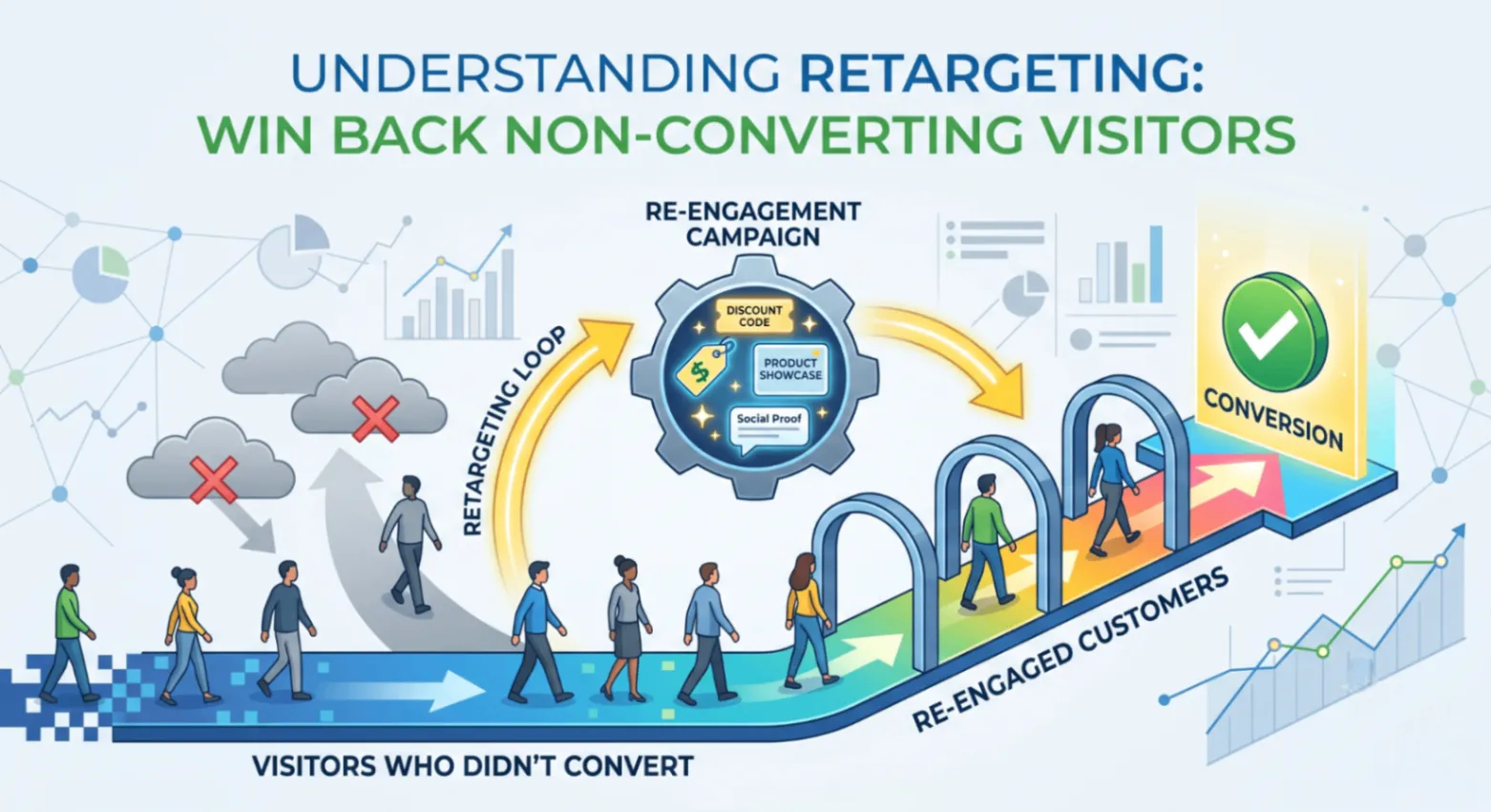
The overwhelming majority of people who visit your site leave without converting — often well over 95% on a first visit. Retargeting exists to do something about them: to re-reach people who already showed interest rather than starting from scratch with strangers. It is usually the single most efficient slice of a paid program, and it is the first place to look when you need more results without a bigger budget.
What It Does, and Why It Works
Retargeting shows ads to people who already interacted with you — visited a page, added to cart, watched a video. Because these audiences are warm, they convert at higher rates and lower cost than cold prospecting.
The gap is stark. A cold prospecting campaign might convert 1% of clicks at, say, a $60 cost per acquisition. A retargeting campaign to people who already visited a product page can convert several times higher and, because the audience is pre-qualified by their own behavior, often at a fraction of that acquisition cost. You are not paying to create interest — only to recover it — which is why retargeting reliably shows some of the best acquisition economics in the account.
Segment by Behavior
Not every non-converter is equal. Someone who abandoned a cart is far closer to buying than someone who read one blog post, and they deserve different messages, offers, and urgency. Segment retargeting audiences by what people actually did, and the campaign stops being one blunt reminder and becomes a set of tailored nudges. Cart abandonment is the highest-value case: these people declared intent by starting checkout, and a well-timed reminder — sometimes with a small incentive — recovers revenue that was nearly lost.
Manage Frequency and Fatigue
Retargeting's strength becomes its liability without limits. The same person seeing your ad twenty times gets annoyed, not persuaded, and you burn budget building resentment. Cap frequency, rotate creative so the message stays fresh, and set sensible window lengths — a high-consideration B2B purchase justifies a longer retargeting window than an impulse buy. And exclude people who already converted: nothing wastes spend and goodwill like advertising a product to someone who bought it yesterday.
Sequence the Story
The best retargeting does not repeat one ad — it tells a story over time, moving someone from a reminder, to social proof, to a specific offer across successive touches. Sequential retargeting mirrors how persuasion actually works, guiding a warm audience toward the decision rather than nagging them toward it. It pairs naturally with strong landing pages and with onsite personalization that continues the message once they return.
Respect the Privacy Shift
The mechanics are changing as third-party cookies decline and privacy rules tighten. Retargeting increasingly relies on first-party data — your own audiences and lists — rather than broad third-party tracking. Build direct relationships and first-party audiences now, and your retargeting stays effective as the old infrastructure fades. This is also why clean attribution matters: retargeting often gets the last-click credit for a sale that awareness and content did the real work to create.
The Bottom Line
Retargeting is the most efficient paid tactic most businesses have, precisely because it recovers interest instead of manufacturing it. Segment by behavior, cap frequency, exclude buyers, sequence the message, and move to first-party data — and it becomes a reliable engine for winning back the visitors you already paid to attract.
Ready to put this into practice? Get in touch to add a retargeting strategy that recovers lost conversions.